Focus: Material Composition · Strengthening Mechanism · Physical Properties · Grade Equivalents
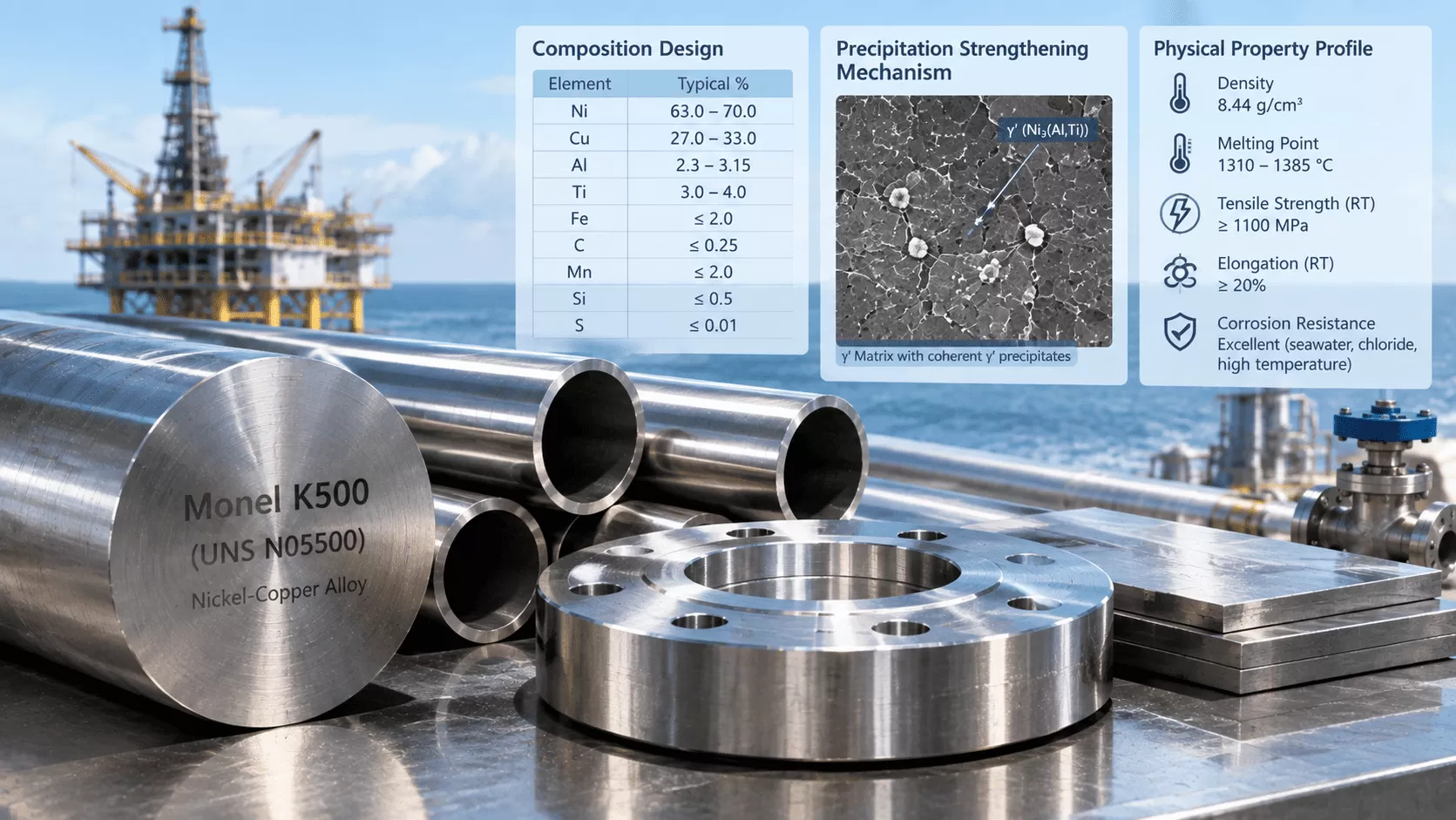
Monel K500 (UNS N05500, DIN 2.4375) is a precipitation-hardenable nickel-copper alloy that delivers approximately twice the strength of Monel 400 while retaining the same exceptional seawater corrosion resistance and non-magnetic characteristics. This article examines the metallurgical design principles behind its aluminum-titanium strengthening system, the mechanism of Ni₃(Al,Ti) precipitate formation during aging, the complete physical and mechanical property profile, and the critical grade designation system that governs specification and procurement. Engineers will find practical guidance on distinguishing Monel K500 from its neighbors and avoiding common selection errors.
In the nickel-copper alloy family, Monel 400 has long been the familiar corrosion-resistant grade, trusted for decades in seawater, hydrofluoric acid, and caustic alkali service. However, its strength is limited. When it comes to high-load applications such as seawater pump shafts, valve stems, and fasteners, Monel 400 struggles to meet mechanical demands.
Monel K500 was developed specifically to resolve this contradiction. It retains the nickel-copper matrix but adds aluminum and titanium, combined with age hardening heat treatment, to raise strength to approximately twice that of Monel 400—while preserving the alloy's signature seawater corrosion resistance and non-magnetic character.
Monel K500 belongs to the nickel-copper system within nickel-based corrosion-resistant alloys and is classified as a precipitation-hardening material. Its standard designations include:
Monel is a registered trademark. Commercial variations such as MonelK500, Monelk-500, monel500, and Alloy K-500 all refer to the same material. For technical agreements and procurement documents, the standard designation—such as UNS N05500 plus delivery condition—should be used as the binding specification. Trade names are for communication convenience only and do not constitute technical terms.
For a broader framework on nickel alloy classification and selection, Ronsco's complete engineer's guide to high-performance nickel alloys provides a comprehensive decision framework covering Inconel, Hastelloy, Monel, and other specialty alloy families.
Table 1: Chemical Composition of Monel K500 (wt%)
| Element | Content (wt%) | Function |
|---|---|---|
| Nickel | 63.0–70.0 | Austenitic matrix; corrosion resistance; non-magnetic source |
| Copper | 27.0–33.0 | Key differentiator; HF and seawater resistance |
| Aluminum | 2.30–3.15 | Core strengthening element; Ni₃(Al,Ti) precipitate formation |
| Titanium | 0.35–0.85 | Core strengthening element; Ni₃(Al,Ti) precipitate formation |
| Iron | ≤2.00 | Residual; high content disrupts precipitation |
| Manganese | ≤1.50 | Residual; high content disrupts precipitation |
| Carbon | ≤0.25 | Minimize grain boundary precipitation |
| Sulfur | ≤0.010 | Hot cracking prevention |
The aluminum and titanium additions are the strengthening core of Monel K500. During aging heat treatment, these elements precipitate as a finely dispersed Ni₃(Al,Ti) gamma-prime phase throughout the austenitic matrix. These nanoscale precipitates act as obstacles to dislocation motion, dramatically increasing the alloy's yield and tensile strength.
Both aluminum and titanium must be strictly controlled within their specified ranges. At the lower limits, insufficient precipitate volume results in inadequate strength. At the upper limits, excessive precipitate formation can impair ductility and toughness. The interplay between these two elements is the defining metallurgical feature that distinguishes Monel K500 from the solid-solution-strengthened Monel 400.
Table 2: Physical Properties of Monel K500
| Property | Value |
|---|---|
| Density | 8.44 g/cm³ |
| Melting Range | 1288–1343°C |
| Thermal Conductivity | 17.6 W/(m·K) |
| Coefficient of Thermal Expansion | 13.7 × 10⁻⁶/K |
| Elastic Modulus | 179 GPa |
The density of 8.44 g/cm³ is close to that of common stainless steels, allowing structural weight estimates to follow similar rules of thumb. The thermal conductivity of 17.6 W/(m·K)—only about one-quarter that of carbon steel—has direct machining implications: cutting heat concentrates at the tool-chip interface, heat dissipation is slow, and tool temperatures rise rapidly. This is one of the primary reasons why Monel K500 requires dedicated tool selection and cutting parameters.
The high elastic modulus combined with non-magnetic behavior gives Monel K500 a unique advantage in seawater environment elastic components and instrument parts. The material is typically non-magnetic, but weak magnetism may appear after aging treatment. If the application specifies magnetic permeability limits, these must be written into the technical specification and verified by measurement.
Table 3: Comparative Positioning of Monel K500 and Related Alloys
| Alloy | Strengthening Mechanism | Key Distinction |
|---|---|---|
| Monel 400 | Solid-solution | Similar corrosion resistance; lower strength |
| Monel K500 | Precipitation (Ni₃(Al,Ti)) | 2× strength; retains corrosion resistance |
| Inconel X-750 | Precipitation (γ′) | Higher temperature capability; different magnetic behavior |
Monel 400 and Monel K500 are not directly interchangeable. While corrosion performance in seawater is similar, the strength difference is substantial. Inconel X-750 offers superior high-temperature capability but differs in magnetic response and seawater service adaptability. Substitution requires item-by-item verification against the specific service conditions.
Monel K500 addresses a specific and persistent engineering problem—the strength limitation of Monel 400 in high-load seawater service—through a precisely controlled aluminum-titanium precipitation strengthening system. The Ni₃(Al,Ti) gamma-prime phase, formed during aging heat treatment, delivers approximately twice the strength of the solid-solution-strengthened Monel 400 while preserving the nickel-copper matrix's exceptional corrosion resistance and non-magnetic character.
Successful specification requires attention to the standard designation system (UNS N05500, DIN 2.4375), the narrow compositional windows for aluminum and titanium, and the magnetic permeability changes that accompany aging. With these factors properly controlled, Monel K500 delivers reliable long-term performance in the most demanding marine and chemical processing applications.
2026-09-20 00:00:00
2026-09-18 00:00:00
2026-09-04 16:07:31



25th floor, C3 Building, Wanda Plaza, Kaifu District, Changsha, Hunan Province, China
 en
en
 ko
ko
 ru
ru
 es
es
 ar
ar
 hi
hi