 en
 ko
 ru
 es
 ar
 hi

S32750 Super Duplex Stainless Steel: How Product Form and Manufacturing Affect Performance
When engineers select S32750 super duplex stainless steel, corrosion resistance and strength are only part of the decision. Product form, manufacturing route, heat-treatment condition, dimensions, and inspection requirements also help determine whether the supplied material is suitable for its intended component and service environment.
1. What Makes S32750 Different from Conventional Stainless Steels?
S32750, commonly associated with Super Duplex 2507, is a super duplex stainless steel with a microstructure consisting primarily of ferrite and austenite. Its chromium, molybdenum, and nitrogen contents contribute to resistance to localized corrosion, including pitting and crevice corrosion in many chloride-containing environments.
The alloy can also provide higher strength than many conventional austenitic stainless steels. It may be considered for selected offshore, seawater, chemical-processing, and oil and gas applications. Suitability still depends on operating temperature, chloride concentration, crevice conditions, stress, fabrication history, and applicable standards.
A composition-based comparison parameter often used for stainless steels is the Pitting Resistance Equivalent Number (PREN). The formula uses the alloy’s chromium (Cr), molybdenum (Mo), and nitrogen (N) contents, expressed as percentages:
For S32750, the PREN value is typically around 41–43, depending on the actual chemical composition. PREN helps compare alloy compositions; it does not independently predict service life or guarantee performance in a particular environment.
2. Why Material Grade Alone Is Not Enough
Products carrying the same alloy designation may be supplied in different product forms, dimensions, delivery conditions, and manufacturing routes. These differences do not change the nominal alloy identity, but they can affect which standards apply, how properties are verified, and whether the product is suitable for the intended component.
- Material identity: grade and specified chemical composition.
- Product specification: standard governing plate, bar, pipe, fitting, or forging.
- Delivery condition: heat treatment and other specified supply conditions.
- Verified properties: test results demonstrated against applicable requirements.
- Component suitability: conformity with design, fabrication, and service requirements.
Mechanical-property values from a plate datasheet should not automatically be used as acceptance criteria for a forging or pipe. Confirm the standard and product form to which each value applies.
3. Choosing the Right Product Form for S32750
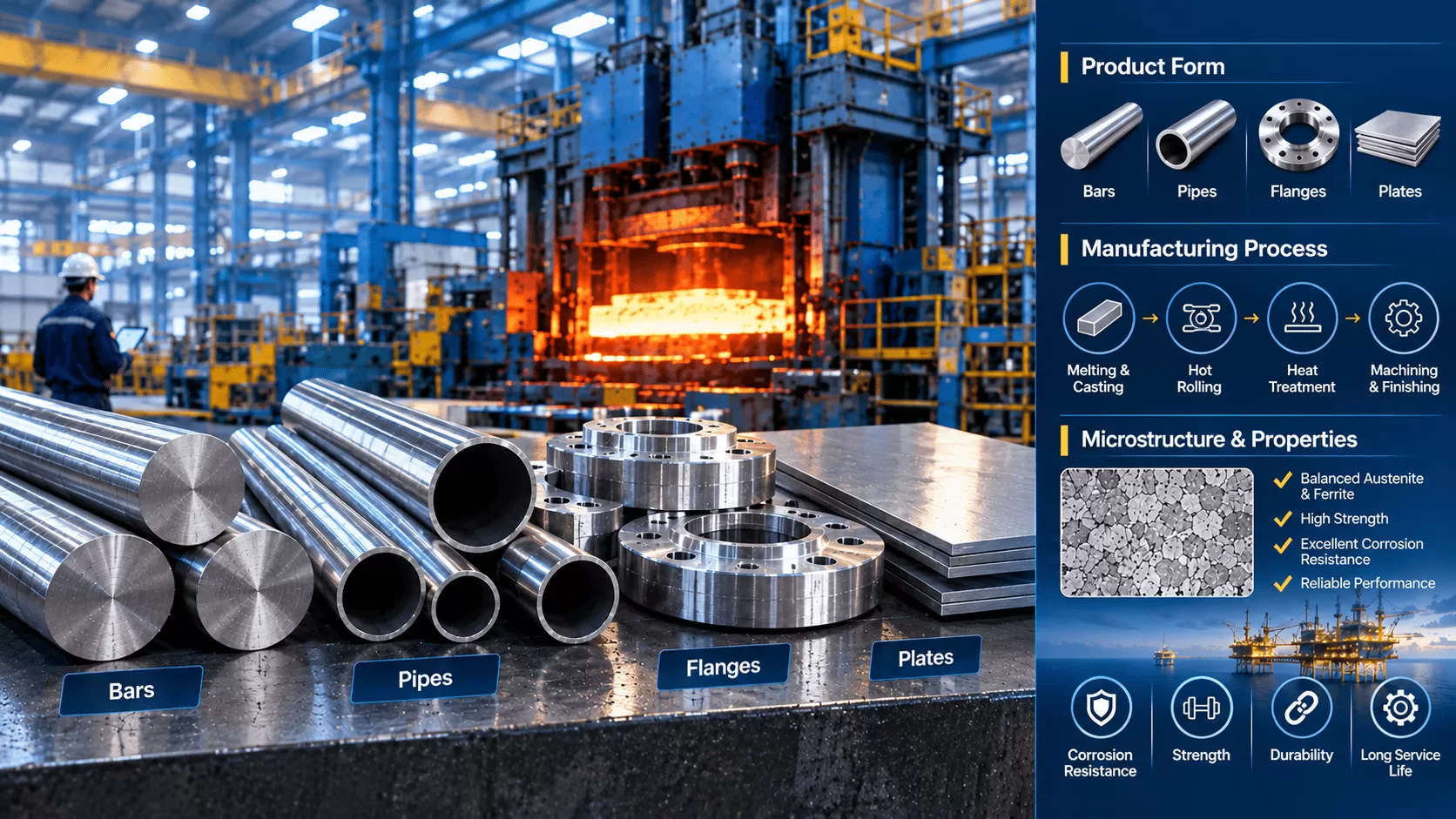
Choose product form around the finished component’s geometry, fabrication route, dimensions, and acceptance criteria. This table gives general selection considerations; availability and specifications should be confirmed for each order.
| Product form | Typical selection considerations | Key points to verify |
|---|---|---|
| Forgings | Components requiring a specified forged form or substantial section | Forging specification, heat treatment, mechanical properties, required NDT |
| Bars and rods | Machined components requiring defined dimensions and material condition | Diameter, length, tolerances, delivery condition, test requirements |
| Plates and sheets | Fabricated structures and components made from flat products | Thickness, product standard, surface condition, mechanical properties |
| Pipes and tubes | Fluid transport, heat exchange, and process systems | Pipe specification, dimensions, wall thickness, manufacturing route, testing |
| Fittings | Piping systems requiring changes in direction, diameter, or connection | Fitting standard, dimensions, design requirements, traceability |
These categories are not interchangeable. The best choice depends on component design, material utilization, machining plan, applicable code, and verified delivery condition. Review Ronsco Alloy’s specialty alloy range and the forgings category for relevant supply options.
4. Manufacturing and Heat Treatment: Where Quality Is Established
Manufacturing requirements vary by product form. Forgings, bars, plates, pipes, and fittings can follow different production routes and may be governed by different product specifications. Start by identifying the actual product and its applicable standard.
Manufacturing route and geometry
Processing history and geometry can affect how properties develop and are verified. For forgings, deformation history and section transitions are important considerations. For other product forms, check the relevant manufacturing route and acceptance requirements against the governing specification rather than inferring them from forging practice.
Solution heat treatment and cooling
For super duplex stainless steel, solution heat treatment and subsequent cooling help establish an appropriate microstructure. Unsuitable thermal exposure can promote detrimental phases, while section thickness and geometry may affect cooling. Specific temperatures, holding times, and cooling requirements should come from the applicable specification and a qualified process.
Microstructure and verification
Ferrite–austenite balance is an important consideration for super duplex grades. Where required, metallographic examination should use defined sampling and acceptance criteria. Agree on the inspection plan before production, especially for components intended for demanding chloride-containing service.
5. What Should Buyers Verify Before Ordering S32750?
- Material designation and specification: state UNS S32750 and the applicable material and product standard.
- Product form and dimensions: identify forging, bar, plate, pipe, tube, or fitting; provide drawings, tolerances, and quantity.
- Delivery condition: specify required heat treatment and supply condition.
- Mechanical properties: define tensile, hardness, impact, or other acceptance criteria as applicable.
- Inspection scope: specify chemical analysis, metallography, NDT, and dimensional checks.
- Certification and traceability: identify required material certificates, heat-treatment records, test reports, and traceability.
- Service environment: provide medium, temperature, pressure, stress, and other relevant operating information.
Not every project requires the same tests. The appropriate scope depends on the governing specification, component design, service risk, and purchase order.
6. Where Is S32750 Used—and When Should Alternatives Be Evaluated?
S32750 may be considered for offshore and subsea equipment, seawater handling and desalination systems, chemical-processing equipment, selected oil and gas components, pumps, valves, and other systems exposed to chloride-containing media.
Selection should be based on the complete operating environment, not a single corrosion-resistance number. Temperature, chloride concentration, stagnant conditions, deposits, crevice geometry, stress, and fabrication details may influence performance.
Where service conditions or design requirements exceed S32750’s capabilities, engineers may evaluate other super duplex grades, super austenitic stainless steels, or nickel-based alloys. The comparison must reflect actual operating conditions, design code, and lifecycle requirements.
Conclusion
S32750 super duplex stainless steel offers a combination of strength and resistance to many chloride-related localized corrosion mechanisms. However, a material designation alone does not establish that every product form is suitable for every application.
A sound selection process connects alloy grade with the correct product specification, manufacturing route, delivery condition, verified properties, and inspection documentation. Reviewing these factors together is a more reliable way to assess whether an S32750 product suits its intended service.
To discuss product forms and project requirements, visit Ronsco Alloy or review the forgings product category.
Frequently Asked Questions
Is S32750 the same as Super Duplex 2507?
UNS S32750 is commonly associated with Super Duplex 2507. Verify the governing standard, product form, and supply requirements before treating designations as interchangeable.
Does product form change the alloy grade?
No. Product form does not change the nominal alloy designation, but different forms may have different standards, manufacturing routes, dimensions, and acceptance requirements.
Does a high PREN guarantee corrosion resistance?
No. Actual performance also depends on the operating environment, microstructure, surface condition, stress, and fabrication history.
What belongs in an S32750 purchase specification?
Identify the grade and governing standard, product form and dimensions, delivery condition, required properties, inspection scope, documentation, and relevant service conditions.
Technical note: Confirm material suitability and acceptance criteria against the applicable product standard, purchase specification, and actual service conditions.