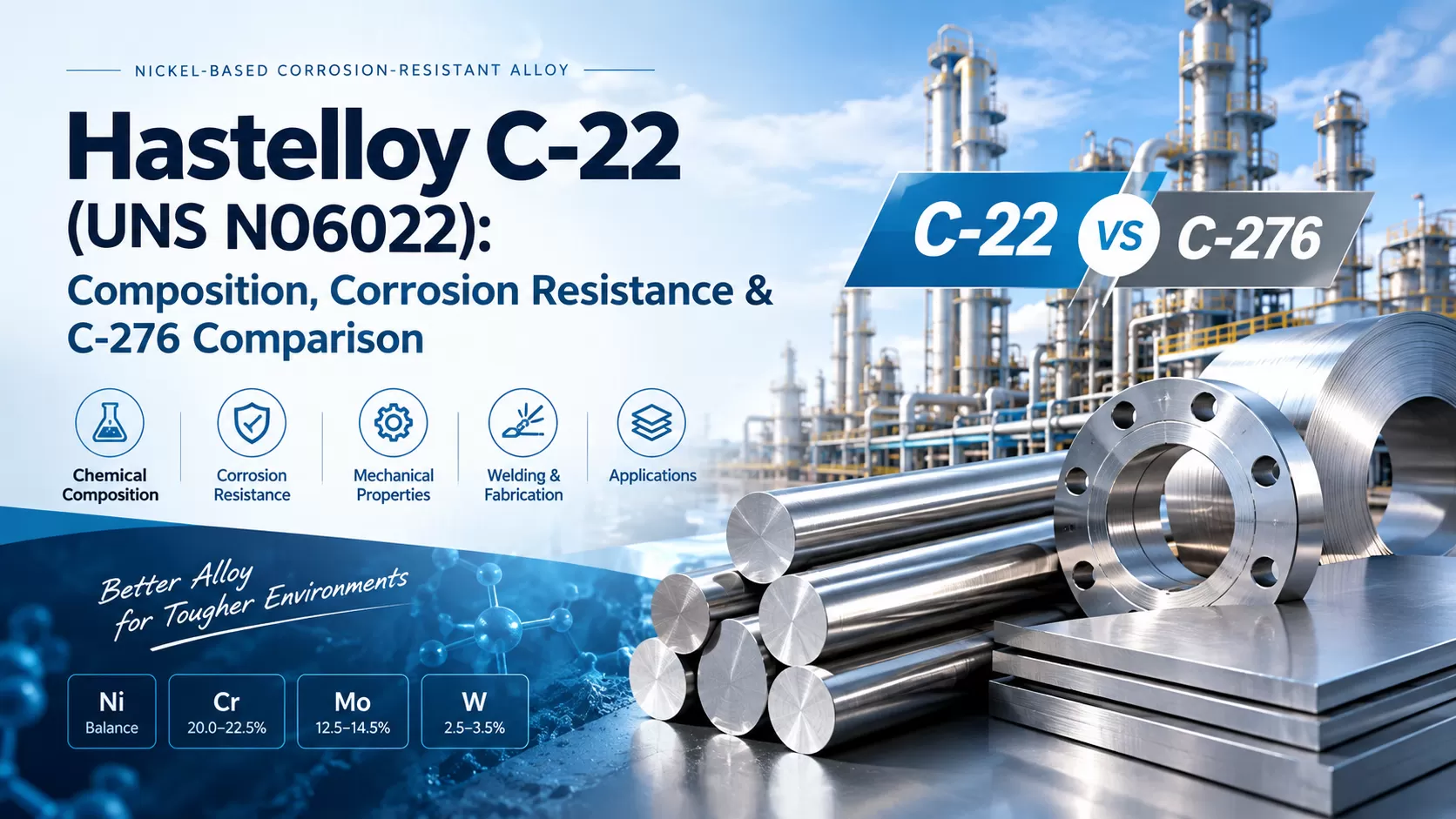
A technical engineering guide to Hastelloy C-22, covering chemical composition, corrosion resistance, mechanical properties, heat treatment, welding, fabrication, applications and material selection against Hastelloy C-276.
Hastelloy C-22 (UNS N06022) is a nickel-chromium-molybdenum-tungsten alloy developed for severe corrosion environments where conventional stainless steels and many other nickel alloys may not provide sufficient corrosion resistance.
The alloy is particularly valuable when equipment is exposed to changing, contaminated or mixed chemical environments containing both oxidizing and reducing species. Its chemical design combines a relatively high chromium content with substantial molybdenum and tungsten additions.
This combination makes Hastelloy C-22 particularly relevant to chemical processing equipment, pollution-control systems, pharmaceutical equipment, marine systems and other applications where corrosion conditions can change during service.
The performance of C-22 is strongly related to its Ni-Cr-Mo-W chemistry. Chromium primarily strengthens resistance to oxidizing media, while molybdenum and tungsten contribute significantly to resistance against reducing acids and localized corrosion.
| Element | Typical / Specified Content (wt.%) | Primary Metallurgical Function |
|---|---|---|
| Nickel (Ni) | Balance | Matrix; overall corrosion and structural stability |
| Chromium (Cr) | 20.0–22.5 | Passive-film formation and oxidizing-media resistance |
| Molybdenum (Mo) | 12.5–14.5 | Reducing-acid and localized corrosion resistance |
| Tungsten (W) | 2.5–3.5 | Improves localized and reducing-environment resistance |
| Iron (Fe) | 2.0–6.0 | Controlled alloying constituent |
| Carbon (C) | ≤ 0.015 | Low level limits carbide precipitation |
| Silicon (Si) | ≤ 0.08 | Controlled to minimize detrimental phases |
| Cobalt (Co) | ≤ 2.5 | Controlled residual/alloying element |
| Vanadium (V) | ≤ 0.35 | Controlled minor alloying element |
Chromium promotes the formation and maintenance of a protective passive film. This is particularly important in oxidizing media, including environments containing nitric acid, ferric ions, cupric ions or wet chlorine.
Molybdenum and tungsten provide additional resistance to reducing acids and localized corrosion mechanisms such as pitting and crevice corrosion. Their combined effect is an important part of the alloy's performance in complex process environments.
Hastelloy C-22 is often compared directly with Hastelloy C-276 because the two alloys share the same fundamental Ni-Cr-Mo-W design philosophy. However, their alloy chemistry reflects different optimization priorities.
For a separate technical analysis of C-276's metallurgical design and corrosion-resistant system, see our detailed guide to Hastelloy C-276 alloy .
Corrosion resistance is the primary reason engineers specify Hastelloy C-22. Its high chromium, molybdenum and tungsten content gives the alloy a broad corrosion-resistance envelope.
The relatively high chromium content provides an important advantage in oxidizing environments. C-22 is commonly considered for chemical systems containing oxidizing contaminants that can be challenging for lower-chromium nickel alloys.
The combined influence of chromium, molybdenum and tungsten makes C-22 highly resistant to localized corrosion. This is particularly important for heat exchangers, piping, vessels, pumps and other equipment containing stagnant or geometrically shielded areas.
C-22 also offers strong resistance to chloride-induced localized corrosion and stress corrosion cracking compared with many conventional stainless steels and lower-alloyed materials.
Hastelloy C-22 is a solid-solution-strengthened nickel-based alloy. Its corrosion performance depends not only on nominal composition but also on maintaining a suitable metallurgical condition during manufacturing and service.
Provides the continuous face-centered-cubic matrix for the alloy.
Enhances passivation and resistance to oxidizing environments.
Improve localized and reducing-environment corrosion resistance.
Helps reduce undesirable precipitation during welding and fabrication.
The very low carbon and controlled silicon content are particularly important for welded structures because excessive precipitation in heat-affected zones can reduce corrosion resistance.
Hastelloy C-22 combines corrosion resistance with useful mechanical strength and ductility. Actual values depend on product form, manufacturing route, heat treatment and applicable specification.
| Property | Typical / Reference Value |
|---|---|
| Density | Approximately 8.69 g/cm³ |
| Melting Range | Approximately 1335–1399°C |
| Elastic Modulus | Approximately 206 GPa |
| Tensile Strength at Room Temperature | ≥ 690 MPa |
| Yield Strength | ≥ 310 MPa |
| Elongation | ≥ 45% |
For procurement, design calculations and pressure-equipment applications, engineers should always verify the required mechanical properties against the applicable material specification and product form rather than relying on generic handbook values.
Solution annealing is used to restore a suitable metallurgical condition following hot working, forming or other manufacturing operations.
Heat the material into the appropriate solution-annealing range.
Maintain sufficient temperature for metallurgical homogenization.
Cool rapidly to limit undesirable precipitation.
Verify dimensions, surface condition and required mechanical properties.
Commonly referenced solution-treatment ranges are approximately 1065–1135°C, depending on the applicable specification and product form. Exact treatment parameters should be controlled according to the relevant material standard and supplier procedure.
Hastelloy C-22 is designed to provide good weldability while maintaining corrosion resistance in welded components. This makes it particularly attractive for fabricated chemical-processing equipment.
ERNiCrMo-10 is commonly associated with C-22 welding applications. Filler selection should be based on the base material, joint design, service environment and applicable welding specification.
The broad corrosion-resistance envelope of C-22 makes it suitable for applications where process chemistry is complex, variable or contaminated.
Reactors, heat exchangers, columns, pumps, valves and piping exposed to aggressive mixed chemical environments.
FGD equipment, absorber components, spray systems, mist eliminators and wet scrubber systems.
High-purity process equipment, reactors, crystallizers and piping requiring corrosion resistance and cleanability.
Pumps, seawater systems and components exposed to chloride-rich marine environments.
Selected equipment used in nuclear fuel processing and aggressive waste-management environments.
Components exposed to chlorine-containing bleaching and process chemicals.
There is no universal winner between C-22 and C-276. The correct alloy depends on the actual process chemistry, temperature, contaminants, corrosion mechanism, fabrication method and required service life.
The process contains oxidizing species, chlorides or changing chemical conditions and a broad corrosion-resistance margin is required.
The process is dominated by strongly reducing acids where the C-276 chemistry may provide an appropriate performance balance.
Consider acid concentration, temperature, chlorides, oxidizers, flow conditions, crevices, welds and expected contamination.
Engineers should therefore select C-22 or C-276 based on actual corrosion data and service conditions rather than simply choosing the alloy with the higher nominal alloying content.
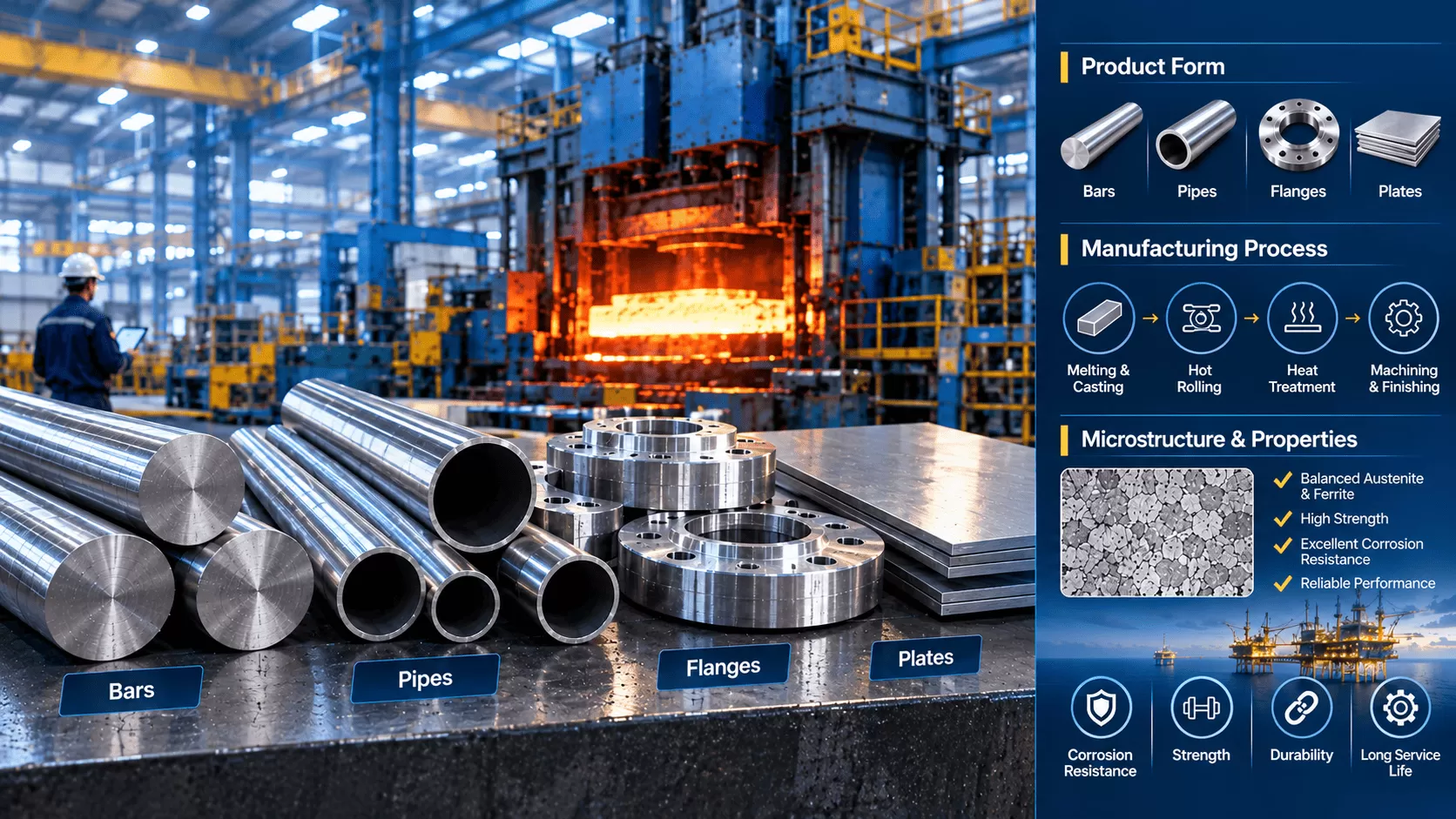
Hastelloy C-22 can be supplied in different product forms depending on equipment design, machining requirements and fabrication route. Alloy-Ronsco's nickel-alloy product range covers several forms suitable for industrial applications.
Select the product form that best matches your engineering, fabrication and procurement requirements.
For example, the nickel alloy bar and rod range includes Hastelloy C22 and C276 bar products, while the nickel alloy forgings range includes Hastelloy C22 and C276 forged products.
When selecting a product form, buyers should specify alloy grade, applicable standard, dimensions, quantity, heat-treatment condition, inspection requirements and required documentation.
Hastelloy C-22 is a nickel-chromium-molybdenum-tungsten corrosion-resistant alloy identified as UNS N06022. It is designed for demanding chemical environments, particularly mixed oxidizing and reducing conditions.
C-22 is primarily nickel, with approximately 20–22.5% chromium, 12.5–14.5% molybdenum and 2.5–3.5% tungsten, together with controlled levels of iron, carbon, silicon and other minor elements.
Neither alloy is universally better. C-22's higher chromium content provides an advantage in many oxidizing and mixed environments, while C-276 remains highly competitive in strongly reducing chemical environments.
Yes. The combination of chromium, molybdenum and tungsten provides strong resistance to localized corrosion, making C-22 suitable for chloride-containing and contaminated process environments.
Yes. C-22 has good weldability when appropriate procedures, filler metals, heat input and contamination controls are used.
Depending on specification and supplier capability, C-22 can be supplied in forms such as bar, rod, plate, sheet, coil and forgings. Alloy-Ronsco provides multiple C-22 product forms for industrial applications.
Hastelloy C-22 is best understood as a carefully balanced nickel-based corrosion-resistant alloy rather than simply a stronger alternative to every other Hastelloy grade.
Its relatively high chromium content improves resistance to oxidizing environments, while molybdenum and tungsten maintain strong resistance to reducing acids and localized corrosion. Low carbon and controlled silicon further support metallurgical stability during fabrication.
Compared with C-276, C-22 is particularly attractive when process conditions can shift between oxidizing and reducing states or when chloride contamination and localized corrosion are major concerns.
Alloy-Ronsco supplies nickel-based alloys and corrosion-resistant materials in multiple product forms, including Hastelloy C-22. Contact our team with your required grade, dimensions, quantity and application requirements.



25th floor, C3 Building, Wanda Plaza, Kaifu District, Changsha, Hunan Province, China
 en
en
 ko
ko
 ru
ru
 es
es
 ar
ar
 hi
hi