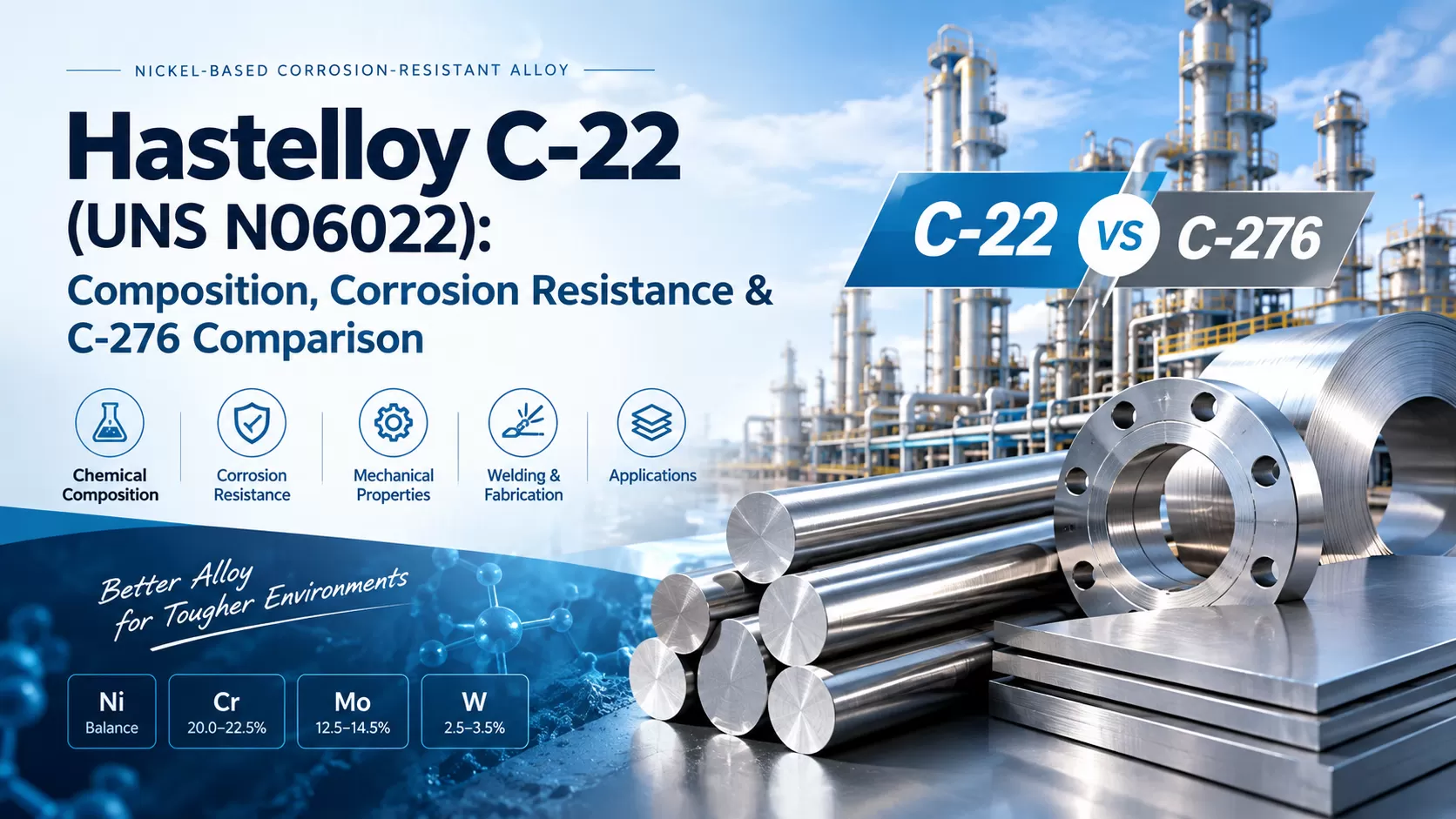
Hastelloy C22 and C276 are both nickel-based corrosion-resistant alloys, but they are optimized for different environments:
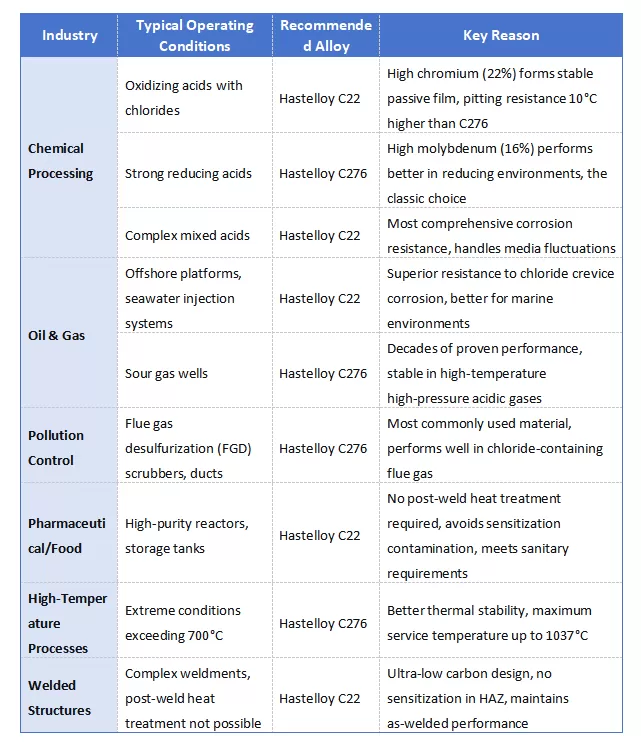
👉 In most mixed chemical environments, engineers tend to prefer C22, while C276 remains the industry standard for reducing acids and high-temperature chemical processing.
Hastelloy is not a single alloy but a family of nickel-based corrosion-resistant alloys. These alloys use nickel (Ni) as the primary matrix and incorporate elements such as chromium (Cr), molybdenum (Mo), and tungsten (W) to achieve excellent resistance to corrosion in harsh chemical environments and high temperatures.
The fundamental differences between the two alloys lie in their chemical composition, which directly determines their corrosion performance.
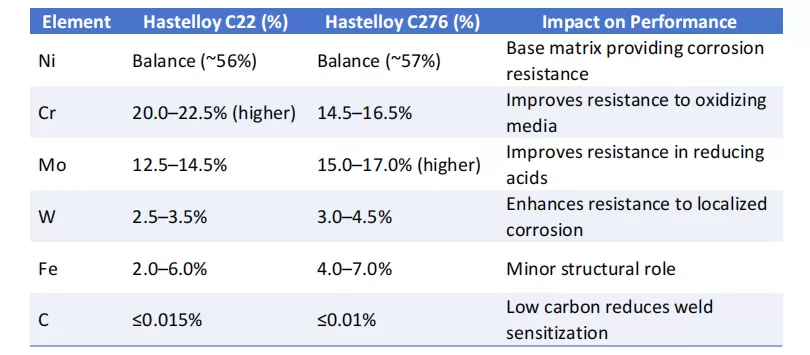
Low Carbon Design: The ultra-low carbon content in C22 helps prevent carbide precipitation at grain boundaries during welding, maintaining excellent corrosion resistance even after welding.
Pitting corrosion is one of the most dangerous forms of corrosion in chloride environments. According to ASTM G48 critical pitting temperature (CPT) testing:

Conclusion: C22 demonstrates higher critical pitting temperatures, providing greater safety margins in chloride-containing environments.
Slow strain rate testing (SSRT) results show:

Conclusion: C22 shows over 50% longer SCC resistance, largely due to its higher chromium content and improved microstructural stability.
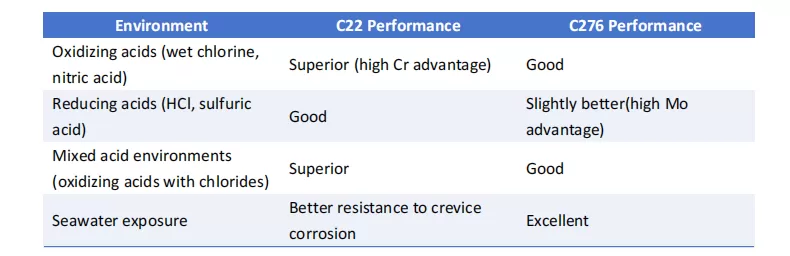
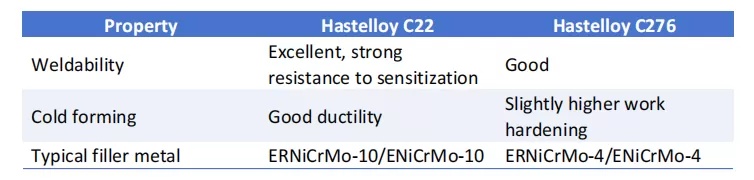
Key Advantage: C22 maintains corrosion resistance even after welding, making it ideal for complex welded structures.
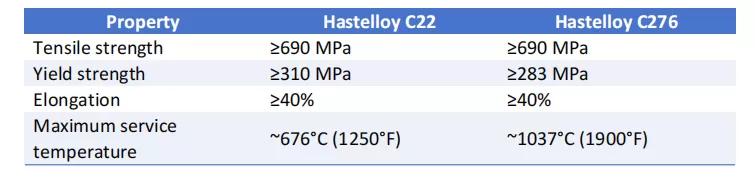
Important note: For high-temperature applications above 700°C, C276 generally offers better thermal stability.
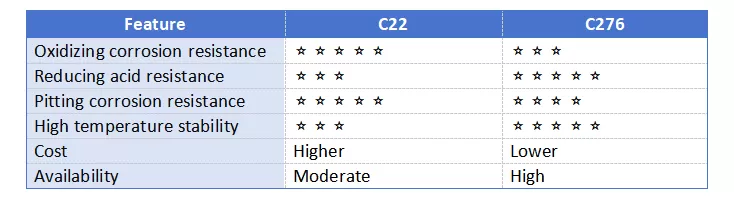
Material Cost: C22 is typically 5-15% more expensive than C276. Interestingly, C22 has a slightly lower density (8.7 g/cm³) compared to C276 (8.9 g/cm³), so the price difference narrows when purchasing by volume.
Procurement Availability: C276 is more readily available in stock with a wider range of specifications; certain C22 specifications may require special ordering.
Lifecycle Cost: In harsh chloride-containing oxidizing environments, C22 offers lower long-term maintenance costs, and the initial investment can be recovered through extended equipment lifespan.
If complex welding without post-weld heat treatment is required, C22 is usually the better option.
C22 improves performance in oxidizing environments and weld corrosion resistance, but it does not fully replace C276, particularly in strongly reducing acids.
In chloride-containing oxidizing environments, the longer service life of C22 can offset the higher initial cost.
Both alloys perform well, but C22 offers slightly better resistance to crevice corrosion.
In moderate environments, they may be interchangeable. However, in strongly oxidizing or strongly reducing conditions, the correct alloy selection becomes critical.
The right choice is not about which alloy is better overall, but which alloy best matches your process conditions. By analyzing the corrosion environment, operating temperature, and fabrication requirements, engineers can make a confident and cost-effective material selection.



25th floor, C3 Building, Wanda Plaza, Kaifu District, Changsha, Hunan Province, China
 en
en
 ko
ko
 ru
ru
 es
es
 ar
ar
 hi
hi