If you've ever sourced materials for aerospace, oil and gas, or power generation industries, you've likely encountered a moment of sticker shock when reviewing quotes for Inconel 718. This nickel-based superalloy commands a price that far exceeds standard stainless steels—often by a factor of 4 to 12 times or more.
But why is inconel 718 so expensive? Is it simply market hype, or are there genuine factors that justify the premium price tag?
In this article, we'll break down the real reasons behind the cost of Inconel 718, from raw materials and complex production processes to stringent certification requirements and market dynamics. Whether you're an engineer specifying materials, a procurement professional managing budgets, or simply curious about high-performance alloys, this comprehensive guide will help you understand exactly where your money goes when you invest in Inconel 718.
Before diving into cost factors, let's briefly understand what Inconel 718 actually is.
Inconel 718 is a precipitation-hardening nickel-chromium-iron superalloy, maintaining excellent mechanical properties from -253°C to 700°C. Its key components include nickel, chromium, niobium and molybdenum, which ensure high tensile strength, creep resistance and corrosion resistance in harsh environments.
It is irreplaceable in critical industries: aerospace, energy, oil and gas, and other advanced fields requiring extreme reliability. Key aerospace applications include jet engine turbine disks and blades, while energy sector uses include gas turbines and nuclear reactor parts, and oil and gas applications cover downhole tools.
Inconel 718’s high cost primarily stems from its reliance on expensive, scarce metals.
Nickel accounts for 50-55% of its mass and is a costly base industrial metal. Inconel 718’s price is highly correlated with LME nickel prices, with fluctuations directly affecting quotations.
Niobium is critical for forming the γ″ strengthening phase and makes up 4.75-5.5% of the alloy. As a rare metal with limited reserves and high extraction costs, it increases raw material expenses.
The alloy also contains significant amounts of chromium and molybdenum. Chromium, at 17-21%, provides corrosion resistance, while molybdenum, at 2.8-3.3%, enhances strength and creep resistance. Both are more expensive than common metals, and their volatile prices add cost uncertainty.
Unlike ordinary steel, Inconel 718 requires specialized, high-cost processes to meet industry standards.
Dual vacuum melting is mandatory for uniform composition, low gas content, and minimal impurities. Each vacuum step doubles or triples melting costs compared to ordinary steel, with advanced equipment requiring precise control to ensure quality.
Precision heat treatment involves solution treatment followed by double aging hardening. This process is energy-intensive and time-consuming, requiring strict temperature control to form strengthening phases.
Forging and rolling must occur within a narrow temperature range to avoid cracking. This demands high energy, slow speeds, and specialized equipment, lowering efficiency and raising costs.
Inconel 718’s inherent properties make post-forming machining extremely challenging and costly.
Severe work hardening and low thermal conductivity cause heat buildup, rapid tool wear, and build-up edges. Its cutting speed is only 10-20% of ordinary steel, extending machining time and labor costs.
Specialized cutting tools are required, including ceramic or cemented carbide options. These tools are expensive and wear quickly, while additional cooling and lubrication strategies add further costs.
Critical components require strict preheating and post-weld heat treatment to prevent cracking, increasing both time and expense.
3D printing powder requires complex gas atomization, sieving, and certification, placing it in a high price range.
Used in safety-critical applications, Inconel 718 must meet strict certifications, adding significant costs.
Key aerospace standards include AMS 5662, AMS 5663, and ASTM B637. For the oil and gas industry, API 6ACRA and NACE MR0175 are required.
Full traceability is mandatory, with each batch requiring detailed documentation covering composition, mechanical properties, heat treatment, and non-destructive testing reports.
Certified materials cost 100-200% more than non-certified ones. Aerospace-grade Inconel 718 is priced higher than industrial-grade due to stricter quality controls.
Market dynamics and supply chains further drive up prices.
Few global manufacturers produce high-quality Inconel 718, creating a concentrated supply market with limited competition.
Rigid demand comes from multiple sectors, especially aerospace, energy, and oil and gas. The aerospace sector’s demand is driven by major engine programs, creating a supply-demand imbalance.
Geopolitical factors, including export restrictions and trade policies, affect the supply of strategic minerals needed for production, causing price fluctuations.
Scrap market changes reflect supply-demand shifts. For example, price drops in the second quarter of 2024 highlight the alloy’s price sensitivity to market dynamics.
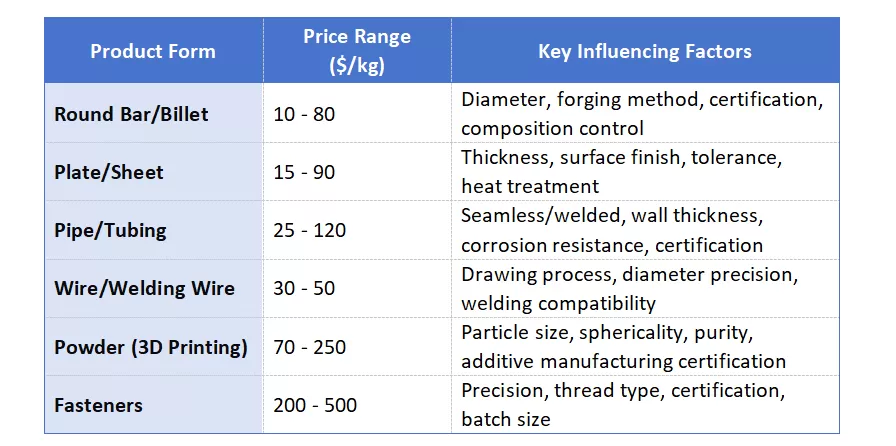
Inconel 718’s price varies by product form, based on production complexity and quality standards. Below are public price ranges and key influences:
The price gap stems from vastly different quality requirements and production costs.
Aerospace-grade Inconel 718 is designed for safety-critical components and requires several strict standards:
These requirements increase production time and costs, raising its price range.
Industrial-grade Inconel 718 is suited for non-safety-critical applications, including:
It has looser composition tolerances, fewer testing requirements, and no mandatory traceability, enabling significant cost savings.
Practical strategies to cut costs without compromising performance:
1. Choose the right grade: Opt for industrial-grade instead of aerospace-grade for non-critical components.
2. Bulk purchasing: Orders of 500kg or more often secure discounts of 10-25%.
3. Off-season purchasing: The first quarter, a traditional slow season, may offer better prices.
4. Long-term contracts: Lock in prices linked to LME nickel to avoid fluctuations.
5. Consider alternatives: Inconel 625 is a lower-cost, corrosion-resistant option, while 316H is suitable for moderate conditions. Haynes 282 and Inconel 740H work for ultra-high temperatures, and Hastelloy C-276 is ideal for还原性 acids.
6. Near-net shaping: Forging, precision casting, or wire arc additive manufacturing reduces machining needs, material waste, and lead times.
Inconel 718’s high price results from four factors: expensive raw materials, complex production, strict certifications, and tight supply-demand. Its price is justified by unparalleled performance in critical industries, where it is irreplaceable for extreme-condition reliability. Procurement professionals should understand price drivers, choose the right grade, optimize purchasing, and consider alternatives to balance cost and performance.
Prices vary by form and grade: round bars range from 10 to 80 USD per kg, plates from 15 to 90 USD per kg, pipes from 25 to 120 USD per kg, wire from 30 to 50 USD per kg, 3D powder from 70 to 250 USD per kg, and fasteners from 200 to 500 USD per kg. Prices are influenced by LME nickel, supply-demand, and geopolitics.
Inconel 718 is typically costlier due to niobium, which enables precipitation hardening, along with complex heat treatment and higher overall strength. Inconel 625 uses solid solution strengthening, resulting in lower raw material and machining costs. Specialized Inconel 625 may match the price of industrial-grade Inconel 718.
No—it is simply more suitable for safety-critical components such as jet engines, due to stricter quality control and traceability. Industrial-grade suffices for non-critical uses such as tooling and laboratory equipment at lower cost, depending on specific needs and budget.
Alternatives depend on the specific application:
No alternative matches Inconel 718’s balance of strength, creep resistance, and corrosion resistance across the temperature range of -253°C to 700°C.
Work with specialized suppliers, consolidate orders where possible, specify only the requirements you genuinely need, and build long-term relationships that allow suppliers to plan production efficiently.



25th floor, C3 Building, Wanda Plaza, Kaifu District, Changsha, Hunan Province, China
 en
en
 ko
ko
 ru
ru
 es
es
 ar
ar
 hi
hi