If you’ve ever tried to choose between 304 and 316 stainless steel, you’ve probably seen the same advice repeated everywhere: 316 is better. But is it really that simple?
People don't encounter this question in just one context. Someone buying a thermos or water bottle might see “316 stainless steel” advertised as a premium feature. A restaurant owner might wonder whether 304 is durable enough for a busy kitchen. An engineer working on a piping system may be told that 316 is required, without a clear explanation why.
In all these cases, the real issue is not simply understanding the techincal differences between 304 and 316 stainless steel. What people actually want to know is do they actually need 316, or is 304 already enough.
Before we dive into the details, here is the simple truth:
In most everyday situations, 304 stainless steel already performs extremely well. It is widely used, reliable, and cost-effective. For indoor use or environments without strong corrosive factors, upgrading to 316 usually does not bring meaningful benefits. However, once the material is exposed to salt, moisture, or chemicals over time, 316 stainless steel becomes the better choice.
This leads to a simple but powerful principle. The harsher the environment, the more valuable 316 becomes. If the environment is stable and controlled, 304 is almost always sufficient.
When people compare 304 vs 316 stainless steel, they often get lost in chemical compositions and technical specs. In reality, there’s only one difference that truly matters for most users: corrosion resistance. The key lies in a single element. 316 stainless steel contains an additional element called molybdenum, which 304 lacks. That small addition improves resistance to chlorides and acidic conditions.
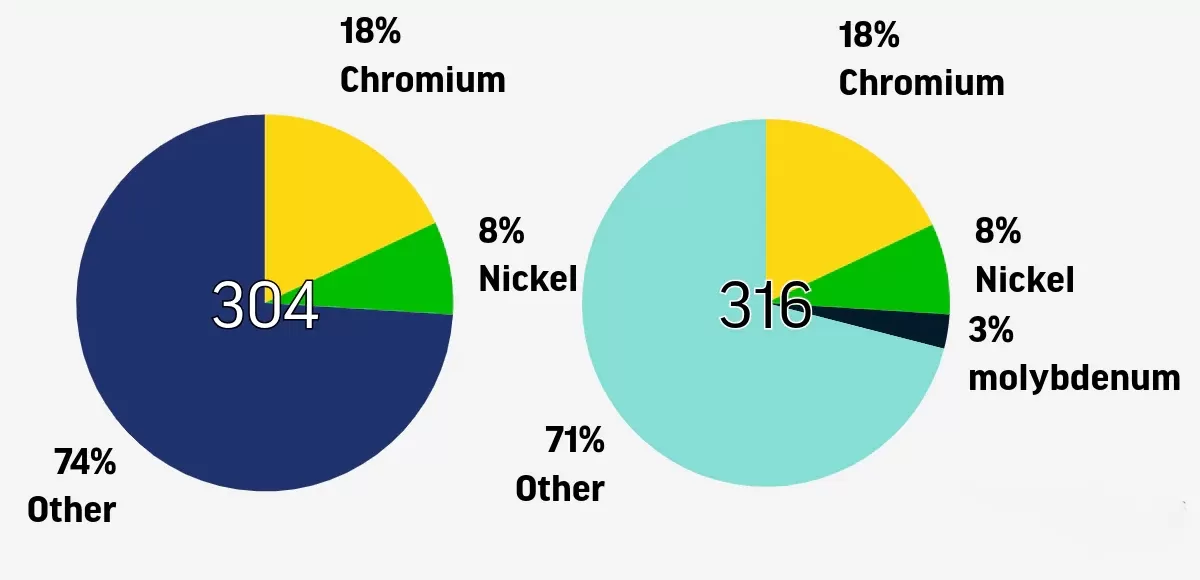
As a result, 304 stainless steel performs very well in standard conditions, while 316 is designed to handle more aggressive exposure. Instead of thinking of 316 as a completely different material, it is more accurate to see it as an upgraded version of 304 for situations where corrosion becomes a real concern.
Instead of memorizing specs, it’s much easier to decide based on your actual usage. Let’s walk through the most common scenarios.
In a typical indoor environment, stainless steel is rarely exposed to anything that can cause serious corrosion. Items such as water bottles, kitchen utensils, and indoor equipment operate under stable conditions, with no constant exposure to salt, strong acids, or extreme humidity. In these cases, 304 stainless steel has already proven itself over decades of use. It is safe for food contact, easy to maintain, and widely accepted as the standard choice.
When food, beverages, and cleaning processes are involved, the environment becomes slightly more demanding. Coffee, tea, fruit juices, and cleaning agents introduce mild acidity or chemical exposure that can affect the material over time. Even so, 304 stainless steel is still commonly used in kitchens and food processing because it offers a good balance between performance and cost. Choosing 316 is not strictly necessary, but it can provide additional resistance in long-term or high-frequency use.
The difference becomes much more noticeable in outdoor or coastal environments. Air near the sea contains salt, which is one of the most aggressive elements for stainless steel. When 304 stainless steel is exposed to this type of environment over time, small corrosion spots can start to appear. In contrast, 316 stainless steel was developed to handle this exposure, maintaining its appearance and structural integrity for much longer.
In industrial applications, the decision between 304 and 316 stainless steel becomes more critical. Systems involving pipes, tanks, or processing equipment often deal with chemicals, moisture, and continuous operation. In these environments, material failure can be costly. This is why 316 stainless steel is frequently specified in industries such as chemical processing, marine engineering, and energy production, where long-term reliability is essential.
When comparing 304 and 316 stainless steel, cost is often the first question. 316 typically carries a 20–40% higher price, depending on form and market conditions, mainly due to the added molybdenum and more complex production process.
But rather than asking why it costs more, the real question is whether that extra expense delivers real value. In corrosive environments, such as coastal areas, chemical exposure, or high-humidity settings, 316’s superior corrosion resistance can prevent maintenance headaches, extend service life, and reduce replacement costs. In these cases, the higher upfront price can actually save money over time. Conversely, in stable indoor conditions where corrosion risk is minimal, the advantages of 316 may never be fully realized. Here, 304 is usually sufficient, and the extra cost offers little practical benefit.
So a simple way to decide is to evaluate both the corrosion risk and the expected service life: high risk and long service life favor 316, while low risk and short-term use make 304 the more economical choice.
Food safety is another area where confusion often appears. Many people assume that 316 stainless steel is safer simply because it is more expensive or more corrosion-resistant.
In reality, both 304 and 316 stainless steel are considered food-grade materials. 304 is widely used in kitchen equipment, food processing machinery, and household products around the world. It meets the requirements for safety and hygiene in most applications.
The advantage of 316 in food-related environments is not about safety, but about durability under certain conditions. For example, if the material is frequently exposed to acidic ingredients or strong cleaning agents, 316 may maintain its surface condition more effectively over time. This can be useful in high-end or high-intensity applications, but it does not mean that 304 is inadequate for normal use.
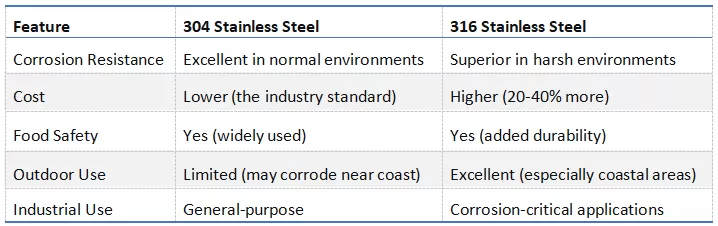
In a summary, 304 stainless steel remains the most widely used option because it performs well in the majority of situations. Meanwhile, 316 stainless steel plays a more specialized role, offering additional protection where the environment demands it. Selecting the right material is not about choosing the most advanced option available. It is about understanding the conditions it will face and making a decision that balances performance, cost, and long-term reliability.



25th floor, C3 Building, Wanda Plaza, Kaifu District, Changsha, Hunan Province, China
 en
en
 ko
ko
 ru
ru
 es
es
 ar
ar
 hi
hi