Selecting the right material for offshore and onshore pipelines is one of the most critical engineering decisions in the oil and gas industry. With sour gas fields becoming increasingly prevalent, natural gas is considered sour when it contains more than 5.7 milligrams of hydrogen sulfide per cubic meter. The demand for corrosion-resistant materials has never been higher. Carbon steels and standard stainless steels simply cannot withstand the combined assault of H₂S, CO₂, chlorides, high pressures, and elevated temperatures found in modern hydrocarbon extraction.
Nickel alloy plates have emerged as the industry’s gold standard for pipeline applications where failure is not an option.
In this guide, we’ll break down 8 best nickel alloy grades for oil and gas pipelines, comparing their corrosion resistance, mechanical properties, temperature limits, NACE MR0175/ISO 15156 compliance, and typical applications. Whether you’re designing downhole tubing, subsea flowlines, topside piping, or wellhead components, you’ll find the technical data you need to make an informed selection.
| Alloy (UNS) | Nickel % | Cr % | Mo % | Key Resistance | Max Temp | NACE Class |
| Alloy 625 (N06625) | 58+ | 20–23 | 8–10 | Pitting, crevice, seawater | 980°C | 4c |
| Alloy C276 (N10276) | 57 | 16 | 16 | Universal corrosion, H₂S | 1900°F | Unrestricted H₂S |
| Alloy 825 (N08825) | 38–46 | 19.5–23.5 | 2.5–3.5 | SSC, reducing acids | 540°C | 4a/4c |
| Alloy 925 (N09925) | 42–46 | 19.5–22.5 | 2.5–3.5 | SSC (superior to 825) | 450°C | 4d |
| Alloy 718 (N07718) | 50–55 | 17–21 | 2.8–3.3 | High strength, creep | 1300°F | For PH alloys |
| Alloy 400 (N04400) | 63+ | — | — | Seawater, HF acids | 540°C | NACE |
| Alloy 2535 (N08535) | 29–36.5 | 24–27 | 2.5–4 | Sour with chlorides | 350°F | 4c |
| Sanicro 276 (N10276) | 57 | 16 | 16 | H₂S/CO₂/Cl | 450°F | Unrestricted |
Best for: Offshore pipelines, subsea equipment, and seawater systems
Alloy 625 is a nickel-chromium-molybdenum superalloy that delivers exceptional strength from cryogenic temperatures up to 980°C. It’s one of the most widely specified nickel alloys in the oil and gas sector, valued for its combination of high tensile strength (min 550 MPa in annealed condition) and outstanding resistance to pitting and crevice corrosion.
Why it stands out: Alloy 625’s molybdenum and niobium content provide solid-solution strengthening and exceptional fatigue resistance. It’s commonly used in subsea risers, manifolds, and downhole tubing in HPHT wells. Under API 5CRA / ISO 13680 standards, it can achieve yield strengths up to 110–140 ksi in cold-worked condition.
Typical applications: Seawater injection lines, offshore platform piping, wellhead components, and chemical injection tubing. Nickel-containing alloys like 625 are relied upon for downhole tubing and safety-critical elements in exploration and production environments.
Cost consideration: Alloy 625 sits at the higher end of the nickel alloy price spectrum due to its high nickel and molybdenum content. Suppliers can provide plating thicknesses from 3mm to 100mm with surface finishes customized to your exact specifications.
Best for: Extreme sour gas environments and universal chemical resistance
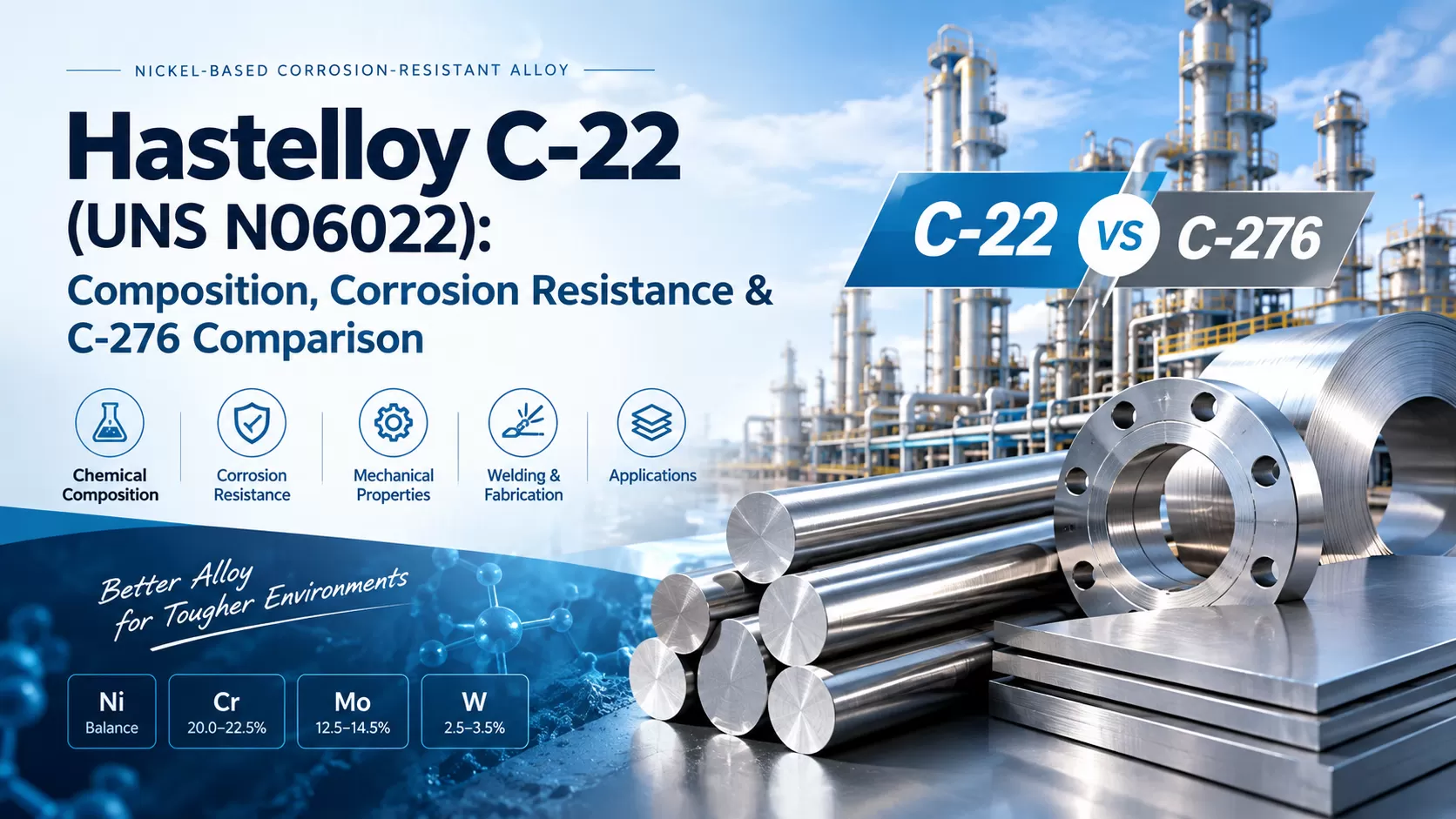
Few materials match the corrosion resistance of Alloy C276. With its unique combination of nickel (57%), chromium (16%), molybdenum (16%), and tungsten (3.5%), C276 stands as one of the most universally corrosion-resistant materials available today. It resists chloride stress corrosion cracking, pitting, and crevice corrosion in the harshest environments.
Why it stands out: According to NACE MR0175/ISO 15156, Sanicro 276 (UNS N10276) can be used in up to 1000 psi partial pressure H₂S at 232°C (450°F) with no limitation on chloride concentration. Below 204°C (400°F), there’s no limit on H₂S level or chloride concentration whatsoever. This makes C276 the go-to choice for sour gas service components where hydrogen sulfide levels are extreme.
Processing advantages: Unlike many high-performance alloys, C276 can be welded using most standard processes without requiring post-weld heat treatment. It’s also machinable in the annealed condition and can be hardened by cold working.
Typical applications: Sour gas compression equipment, natural gas sweetening systems, downhole tubulars for severe sour wells, and Acid Gas Injection (AGI) well components.
Best for: Sour gas pipelines and downhole tubing in HPHT conditions
Alloy 825 (Incoloy 825) has been widely used in sour gas wells worldwide for decades. This titanium-stabilized nickel-iron-chromium alloy contains approximately 40% nickel and offers excellent resistance to sulfide stress cracking and general corrosion in reducing acid environments.
Why it stands out: The addition of copper (1.5–3%) enhances resistance to sulfuric acid, while molybdenum (2.5–3.5%) improves pitting resistance. Alloy 825 offers increased resistance to H₂S effects relative to stainless steels, making it suitable for downhole tubular components, packers, and other subsurface equipment in sour wells with high-pressure and high-temperature conditions.
Under the NACE MR0175/ISO 15156 classification system, Alloy 825 falls under types 4a and 4c for downhole applications, providing well-defined environmental limits for safe operation. It’s particularly valued for its combination of relatively moderate cost (among nickel alloys) with proven long-term field performance.
Typical applications: Sour gas gathering pipelines, downhole tubing in high-CO₂/H₂S wells, control lines, and chemical injection systems.
Best for: Extreme sour gas with high chloride concentrations
Incoloy 925 builds upon the foundation of Alloy 825 but adds precipitation hardening capability for significantly higher strength. It offers unbeatable corrosion resistance, especially for sulfide stress cracking, and is commonly used in sour gas environments for downhole tubing, subsea valves, and petrochemical safety equipment.
Why it stands out: Alloy 925 provides performance benefits for specialized design requirements—it hadn’t been utilized for commercial oilfield gate valves before being introduced as a candidate for future oil field applications that demand both high strength and extreme corrosion resistance. Its strength characteristics come from aluminum and titanium additions, which form gamma-prime precipitates during heat treatment.
Under MR0175/ISO 15156, Alloy 925 is classified as a type 4d alloy, with no restrictions on H₂S partial pressure below 300°F and resistance to 300 psi H₂S at 425°F. This makes it suitable for severely sour wells where Alloy 825’s strength limits are insufficient.
Typical applications: High-strength downhole tubular components, subsea wellhead equipment, petrochemical safety equipment, and high-pressure sour gas pipelines.
Best for: Wellhead components, deep drilling tools, and high-temperature service
Alloy 718 is a precipitation-hardenable nickel-chromium superalloy that delivers exceptional creep resistance, fatigue resistance, and tensile strength at temperatures ranging from cryogenic to 1300°F. It’s widely used in critical applications where high strength and corrosion resistance must coexist.
Why it stands out: API variants of Alloy 718 meet American Petroleum Institute requirements, with BOHLER variants achieving minimum yield strength of 150 ksi. The alloy’s excellent weldability (it resists post-weld cracking better than many precipitation-hardened alloys) makes it a preferred choice for complex fabricated components. In upstream environments, Alloy 718 is utilized for wellhead fittings, connectors, valves, deep drilling tools, subsea risers, manifolds, and gas turbine parts.
Typical applications: Subsea production systems, wellhead equipment, safety valves, springs and fasteners in corrosive service, and gas turbine components.
Best for: Marine pipelines, seawater cooling systems, and HF acid service
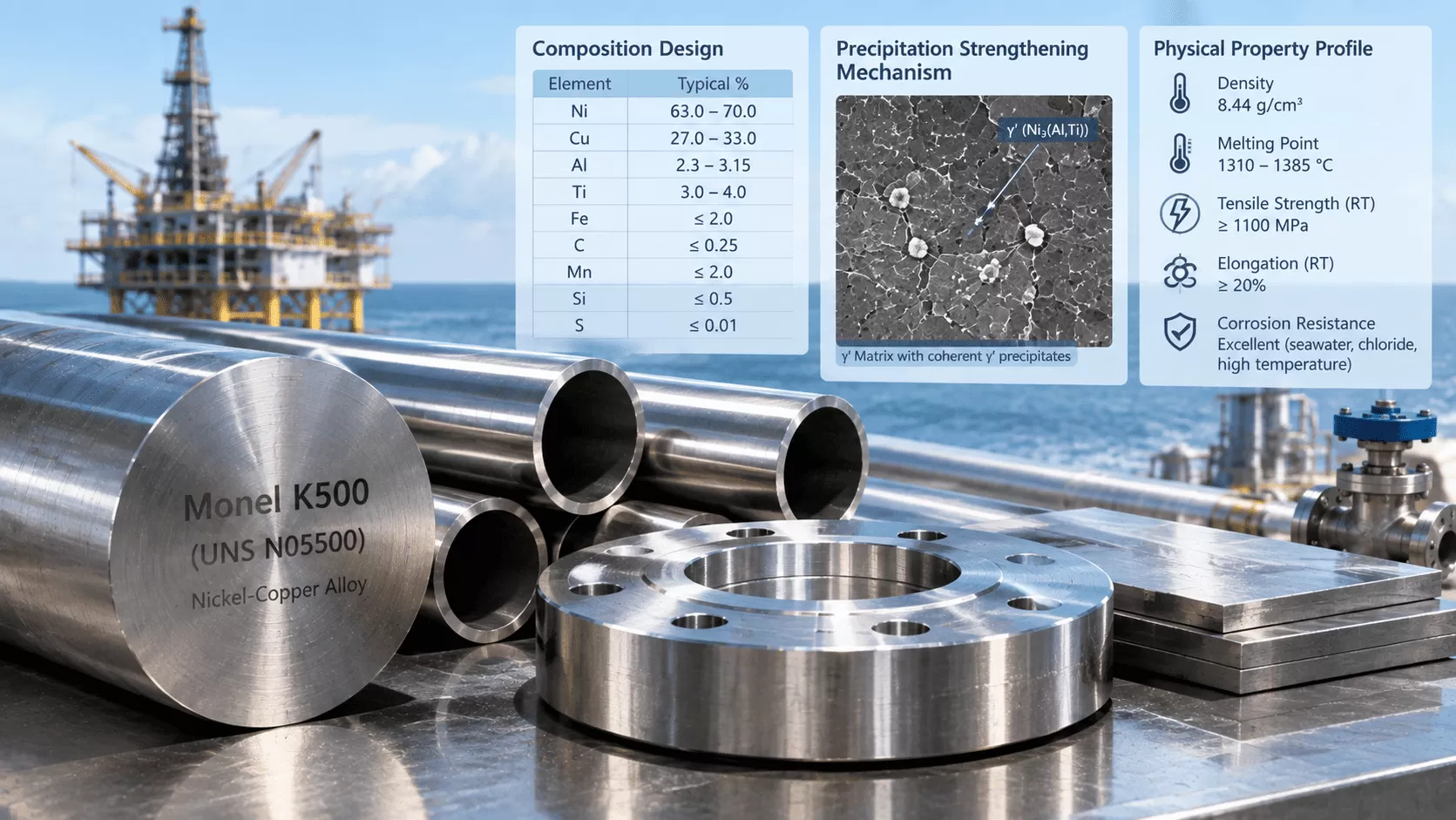
Monel 400 is a nickel-copper alloy (NiCu32Fe2Mn) with approximately 63% nickel and 28–34% copper. It offers excellent resistance to seawater and chloralkali corrosion, ensuring superior durability in highly aggressive marine environments.
Why it stands out: The alloy’s unique combination of high mechanical properties makes it suitable for structural and load-bearing components exposed to extreme maritime conditions. It’s compatible with cold working, deep drawing, and welding, allowing precise fabrication without compromising corrosion resistance. Monel 400 plays an essential role in offshore oil and gas gaskets, piping, and mechanical components needing durability under exposure to corrosive fluids.
Typical applications: Seawater piping systems, marine platform structural components, offshore gaskets and heat exchangers, and hydrofluoric acid service in refinery alkylation units.
Best for: HPHT sour wells with moderate chloride levels
Alloy 2535 is a cold-hardened nickel-based alloy engineered specifically for corrosion resistance in highly sour environments with moderate chloride levels. It provides high strength up to 350°F and is widely used in downhole tubular components, packers, and subsurface equipment in sour wells under HPHT conditions, as well as in AGI wells.
Why it stands out: Compared to stainless steels, Alloy 2535 offers enhanced protection against H₂S effects. In the annealed condition, yield strengths may range from 30 to 55 ksi, while pipe is typically supplied in cold-hardened condition with yield strengths between 110 and 160 ksi. UNS N08535 is classified under MR0175/ISO15156 as a type 4c alloy, with no restrictions for H₂S partial pressure below 270°F, and it can withstand 200 psi H₂S at 350°F.
Typical applications: HPHT downhole tubulars, packers, control lines, and Acid Gas Injection well components.
Best for: Severely sour wells with elevated temperatures
HASTELLOY Alloy G2 (UNS N06975) is a cold-hardened nickel-based alloy designed to provide exceptional corrosion resistance in highly sour environments with high chloride content while maintaining high strength up to 400°F.
Why it stands out: The high nickel (37–52%) and molybdenum (5–7%) content extends the sour service limits of nickel alloys and offers excellent resistance to chlorides and dissolved oxygen. Under MR0175/ISO15156, Alloy G2 is classified as a type 4d alloy like Alloy 925, with no restrictions on H₂S partial pressure below 300°F and resistance to 300 psi H₂S at 425°F. It’s designed for severely sour wells with HPHT conditions that exceed the capabilities of Alloy 825 or Alloy 2535.
Typical applications: High-temperature sour gas pipelines, saltwater injection wells, AGI systems, and downhole tubulars in the most demanding HPHT sour service applications.
Don’t just pick the most expensive one. Do this instead:
1. Get your service numbers – H₂S partial pressure, CO₂, chlorides (ppm), temperature, pH. Without these, you’re guessing.
2. Check failure modes – SSC? Look at high-nickel solid-solution alloys (C276, 825). Pitting? PRE number matters (C276 PRE=68 is elite). Seawater? Monel 400.
3. Strength needed – Annealed alloys run 30–55 ksi. Cold-worked or PH alloys go 110–160 ksi. Don’t overspec.
4. Weldability – C276 welds without PWHT. PH grades like 718 and 925 need careful heat treatment. Factor that into your fab plan.
5. Budget reality – Nickel prices swing. In 2025, the global wear-resistant alloy plate market was about 1.46 million tons at ~$5k/ton base, but pipeline-grade specialty plates cost more. Get quotes.
For sour service applications in the oil and gas industry, NACE MR0175/ISO 15156 is the governing standard for material selection to prevent sulfide stress cracking. This standard has become the global benchmark for sour service, providing environmental and materials limits for corrosion-resistant alloys including all nickel-based alloys discussed in this guide.
The standard classifies nickel alloys into types:
Recent technical circulars have updated these classifications, and API Specification 6A compliance is now acceptable for solid-solution nickel-based alloy wellhead and Christmas tree components, expanding the applicability of these alloys.
An important note: Before finalizing any nickel alloy selection, verify that the chosen grade and condition (annealed vs. cold-worked vs. precipitation-hardened) are explicitly listed in Annex A, Table A.14 (for solid-solution alloys) or relevant precipitation-hardening tables of NACE MR0175/ISO 15156 for your specific combination of H₂S, temperature, pH, and chloride levels. Environmental limits differ significantly between alloy families—what works for Alloy 825 at 200°F may not be approved for Alloy 718 under the same conditions.
There's no single best nickel alloy plate, only the best fit for your specific H₂S, temp, chlorides, and mechanical needs. For extreme sour with no limits, C276 wins. For cost-effective sour service, start with 825. For high-strength sour, look at 925 or 718. And always, always verify NACE compliance.
If you're designing a pipeline that could kill someone or spill millions of dollars when it fails, don't cut corners on alloy selection. Talk to a metallurgist, check the standards, and buy from a reputable supplier.
1. Which nickel alloy is best for H₂S sour service?
For extreme H₂S service without temperature or chloride limits, Alloy C276 (UNS N10276) is the top choice under NACE MR0175. For high-strength requirements in sour gas, Alloy 925 (UNS N09925) provides superior SSC resistance combined with precipitation-hardened strength.
2. Can nickel alloy plates be welded without special procedures?
Some can. Alloy C276 can be welded by most standard processes without post-weld heat treatment. Others, particularly precipitation-hardened alloys like 718 and 925, require careful heat treatment protocols. Always consult the alloy data sheet.
3. How do I verify NACE compliance for a nickel alloy plate?
Request material test reports (MTRs) from your supplier confirming that the heat meets NACE MR0175/ISO 15156 requirements, including hardness testing and documented environmental limits from Annex A.
4. What's the typical lead time for custom nickel alloy plates?
Lead times vary by grade, thickness, and quantity. Standard sizes from stock may ship within 1–2 weeks. Custom sizes and specialized grades typically require 6–10 weeks depending on mill schedule.
5. Are there lean alternatives that cost less than nickel alloys?
Alloys like Sanicro 35 have been developed as more cost-effective alternatives to traditional nickel-based alloys for certain applications, but they don’t match the extreme performance of grades like C276 or 925 in the most demanding sour service environments.
2026-09-20 00:00:00
2026-09-18 00:00:00
2026-09-04 16:07:31



25th floor, C3 Building, Wanda Plaza, Kaifu District, Changsha, Hunan Province, China
 en
en
 ko
ko
 ru
ru
 es
es
 ar
ar
 hi
hi