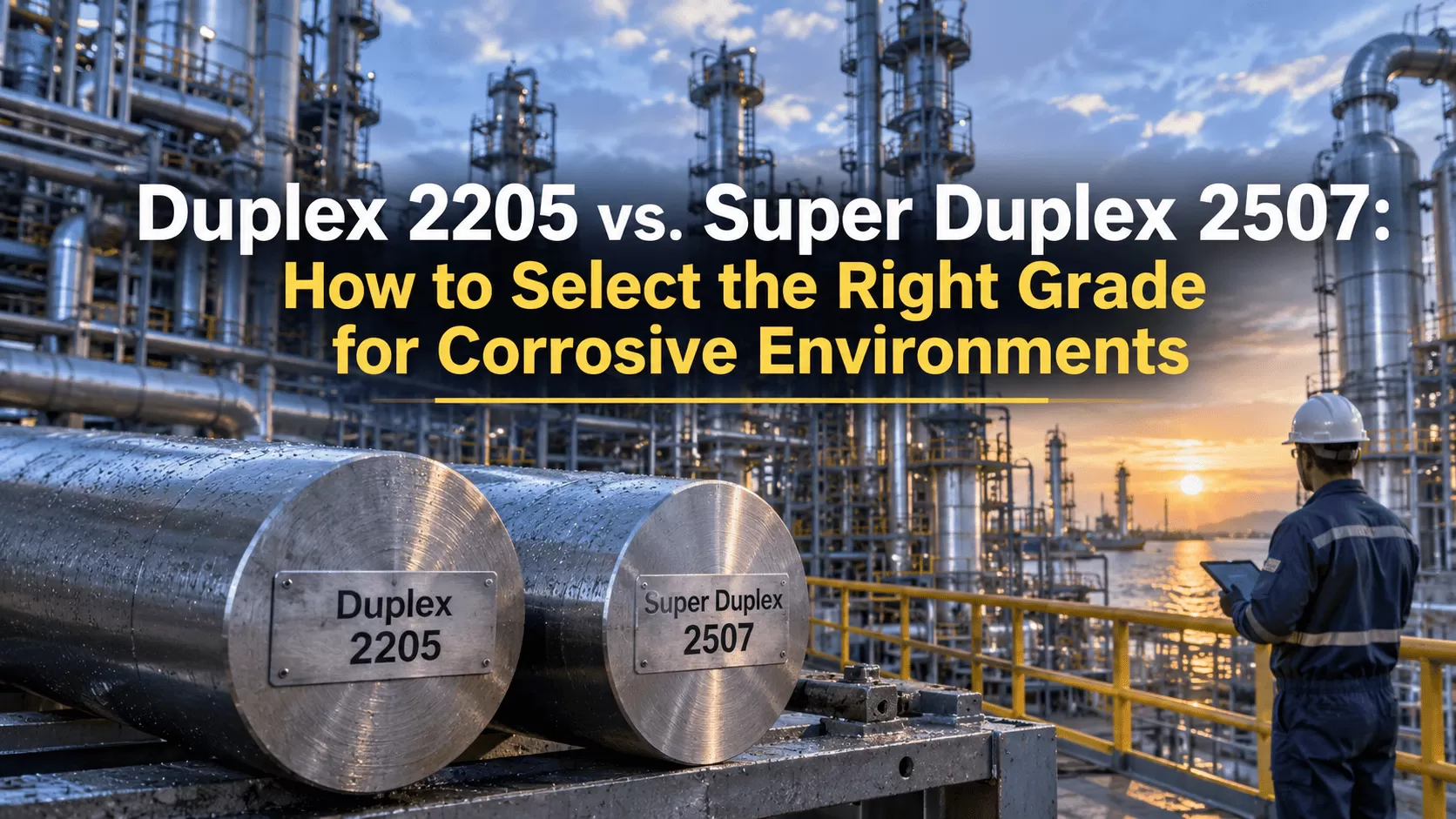
Duplex stainless steel is widely used in demanding industrial environments where high mechanical strength, corrosion resistance, and long-term reliability are essential. Combining an austenitic-ferritic microstructure, duplex stainless steel offers a distinctive balance of properties that makes it an attractive alternative to conventional austenitic stainless steels in many engineering applications.
From offshore oil and gas equipment to seawater desalination systems and chemical processing facilities, duplex stainless steel grades such as 2205 and super duplex 2507 provide reliable performance under challenging operating conditions.
However, selecting the right grade requires more than comparing nominal strength or corrosion resistance. Factors such as chloride concentration, operating temperature, mechanical loading, fabrication methods, and applicable material standards must also be considered.
In this guide, Ronsco Alloy explores the properties, grades, corrosion resistance, manufacturing considerations, and industrial applications of duplex stainless steel to help engineers, designers, and procurement professionals make informed material selection decisions.
Duplex stainless steel is a family of stainless steels characterized by a two-phase microstructure consisting primarily of austenite and ferrite. In properly processed duplex grades, these two phases are balanced to provide a combination of mechanical strength, toughness, and corrosion resistance.
Compared with conventional austenitic stainless steels such as 304 and 316L, duplex stainless steels generally offer higher yield strength and improved resistance to chloride-induced stress corrosion cracking under many service conditions. Performance depends on chemical composition, phase balance, heat treatment, and manufacturing quality.
Duplex stainless steel is available in several grades designed for different combinations of strength, corrosion resistance, and manufacturing requirements.
| Grade | Classification | Common UNS Designation | Key Characteristics |
|---|---|---|---|
| 2304 | Lean Duplex | S32304 | Good strength and corrosion resistance in suitable moderate-service environments |
| 2205 | Standard Duplex | S31803 / S32205 | Balanced mechanical strength and corrosion resistance |
| 2507 | Super Duplex | S32750 | Enhanced resistance to localized corrosion in demanding environments |
| F55 | Super Duplex | S32760 | High strength and corrosion resistance in suitable chloride-containing environments |
These designations identify common grades, but they should not be treated as universally interchangeable. Verify chemical composition, product form, mechanical requirements, and applicable standards for each order.
Duplex 2205 is one of the most widely used standard duplex stainless steel grades. It typically contains approximately 22% chromium, 5% nickel, 3% molybdenum, and nitrogen, with exact composition determined by the applicable specification.
Its balance of strength and corrosion resistance makes 2205 suitable for chemical processing equipment, industrial piping, heat exchangers, storage tanks, and selected oil and gas components.
For material specifications and product information, explore Ronsco Alloy's Duplex 2205 Stainless Steel page.
Super duplex 2507 is a highly alloyed duplex stainless steel typically containing approximately 25% chromium, 7% nickel, 4% molybdenum, and nitrogen. Its composition generally provides greater resistance to localized corrosion than standard duplex 2205.
Typical applications include seawater piping systems, offshore equipment, desalination facilities, pumps, valves, and selected chemical processing components.
Super duplex 2507 is not automatically suitable for every aggressive chemical or sour-service environment. Qualification must consider the complete operating conditions and applicable requirements. For product information, visit Ronsco Alloy's Super Duplex 2507 Pipe page.
F55 is a common designation associated with super duplex stainless steel UNS S32760. This grade contains chromium, nickel, molybdenum, nitrogen, and additional alloying elements, including tungsten and copper. It is designed for applications requiring high strength and resistance to localized corrosion in demanding environments.
Typical applications include offshore equipment, pumps, valves, and components exposed to chloride-containing process fluids. F55 and 2507 are different grades and should be specified according to the required composition, product standard, and service conditions.
Corrosion resistance is a primary reason engineers select duplex stainless steel. Performance is influenced by alloy composition, microstructure, surface condition, temperature, and service chemistry.
Pitting corrosion can develop when the passive film on stainless steel breaks down in an aggressive environment. Chloride ions are an important factor in many pitting-related failures. Crevice corrosion can occur in confined areas where fluid circulation is restricted, such as beneath deposits, gaskets, and tightly fitted components.
Chromium helps establish the protective passive film, while molybdenum and nitrogen contribute to improved resistance to localized corrosion. Super duplex 2507 generally provides greater resistance to pitting and crevice corrosion than standard duplex 2205, but neither grade is immune under all operating conditions.
Chloride stress corrosion cracking occurs when susceptible materials are exposed to a combination of tensile stress, chloride-containing environments, and temperature. Duplex stainless steels generally offer improved resistance compared with conventional austenitic stainless steels under many relevant conditions.
Material selection should account for operating temperature, residual stresses, chloride concentration, fabrication quality, and relevant industry requirements.
The Pitting Resistance Equivalent Number (PREN) is a compositional index used to compare the relative pitting resistance of stainless steel grades.
Common PREN Formula
PREN = %Cr + 3.3 × %Mo + 16 × %N
Some formulas include additional alloying elements, such as tungsten, depending on the material system and calculation convention. Typical duplex 2205 compositions produce PREN values in the mid-30s, while super duplex 2507 commonly achieves values above 40. Exact values depend on composition and the formula used.
PREN is useful for preliminary comparisons, but it does not directly predict corrosion performance in every service environment. Testing, operating conditions, surface finish, and applicable material requirements must also be considered.
The mechanical properties and corrosion resistance of duplex stainless steel depend strongly on its microstructure. Appropriate manufacturing controls are essential to maintaining material performance.
Solution annealing establishes a suitable microstructure and dissolves undesirable precipitates. The material is heated within the specified temperature range and cooled according to the grade and product standard. Temperature, holding time, and cooling rate influence the balance between austenite and ferrite.
An excessive ferrite fraction may reduce toughness and affect corrosion performance. The acceptable phase balance should be determined according to the relevant material specification and application, rather than assuming that every duplex grade must contain exactly 50% of each phase.
Sigma phase is a brittle intermetallic phase that can form under certain temperature and time conditions. Its precipitation can reduce impact toughness and ductility while degrading corrosion resistance. Precipitation kinetics depend on alloy grade, initial microstructure, temperature, and exposure time.
Duplex stainless steel manufacturing therefore requires careful control of thermal cycles during heat treatment, welding, and other high-temperature operations.
Welding duplex stainless steel requires careful control of heat input, interpass temperature, filler material, and cooling conditions. Excessively rapid cooling can result in an undesirable ferrite-rich microstructure, while unsuitable thermal cycles may promote detrimental phase precipitation.
Welding procedures should be qualified for the relevant grade, thickness, joint configuration, and service requirements. For critical applications, weld inspection and material testing may be required.
Duplex stainless steels combine high strength with significant work hardening, which can make machining and forming more demanding than working with some conventional stainless steels. Fabrication planning should consider cutting parameters, tool selection, forming loads, surface condition, and residual stresses.
Material traceability and process control are especially important for pressure-containing equipment and other safety-critical components.
Duplex stainless steel is used across industries that require a combination of structural strength and corrosion resistance. The most suitable grade depends on the operating environment and component requirements.
The oil and gas industry uses duplex stainless steel in selected piping systems, heat exchangers, pressure-containing components, and offshore equipment. For sour-service applications involving hydrogen sulfide, qualification must account for the applicable sour-service standard, environmental conditions, hardness limits, and project specifications.
Marine and desalination facilities use materials exposed to seawater, chloride-rich fluids, and variable operating conditions. Duplex 2205 and super duplex 2507 may be used in selected seawater piping, pumps, valves, and heat exchanger systems. Super duplex grades are often considered where pitting and crevice corrosion risks are high.
Duplex stainless steel can be used in selected storage tanks, process piping, heat exchangers, and pressure-containing equipment. The appropriate grade depends on the chemicals, concentration, temperature, pressure, and potential corrosion mechanisms.
Pulp and paper production can expose equipment to corrosive process fluids, bleaching chemicals, and elevated temperatures. Duplex stainless steel is used in selected process vessels and piping systems where its combination of strength and corrosion resistance offers practical advantages.
Water treatment and infrastructure projects may use duplex stainless steel in tanks, piping, pumps, and structural components. Engineers should evaluate water chemistry, disinfectant levels, chloride concentration, temperature, and maintenance conditions before finalizing material selection.
Selecting duplex stainless steel requires balancing corrosion resistance, mechanical properties, fabrication requirements, and total lifecycle cost. The highest-alloyed grade is not necessarily the most economical choice for every application.
| Selection Factor | Duplex 2205 | Super Duplex 2507 |
|---|---|---|
| Classification | Standard duplex | Super duplex |
| Typical alloy composition | Approx. 22% Cr, 5% Ni, 3% Mo | Approx. 25% Cr, 7% Ni, 4% Mo |
| Mechanical strength | High | High; depends on product form and specification |
| Localized corrosion resistance | Good in suitable environments | Generally higher in demanding chloride environments |
| Typical applications | Industrial piping, chemical processing, heat exchangers | Offshore equipment, seawater systems, desalination |
| Material cost | Often lower than 2507 | Often higher than 2205 |
These are general comparisons, not substitutes for certified material data. Engineers should evaluate the operating environment, required mechanical properties, fabrication conditions, applicable design codes, and procurement costs.
316L is a widely used austenitic stainless steel with good corrosion resistance and established fabrication characteristics. Duplex 2205 generally offers higher yield strength and better resistance to chloride stress corrosion cracking under many relevant conditions. However, 316L may remain preferable where its corrosion performance is sufficient and fabrication characteristics or overall cost offer advantages.
Duplex stainless steel should be selected with careful attention to operating temperature. Prolonged exposure to certain intermediate temperature ranges can promote phase transformations that reduce toughness and corrosion resistance. For elevated-temperature service, verify applicable material limits, design codes, and qualification requirements.
Material price is only one part of the overall cost of an industrial component. A duplex grade with higher initial material costs may offer lifecycle benefits if its strength enables a more efficient design or its corrosion resistance reduces maintenance requirements. Fabrication complexity, machining costs, inspection requirements, and the consequences of material failure must also be considered.
Ronsco Alloy supports industrial material requirements with stainless steel products in various forms and grades. For duplex stainless steel applications, material selection should begin with the required grade, product form, dimensions, applicable standard, and service conditions.
Explore the following product categories on the Ronsco Alloy website:
For grade-specific information, review the Duplex 2205 material page and the Super Duplex 2507 pipe product page.
When requesting a quotation, providing the material grade, dimensions, quantity, applicable standard, delivery condition, and inspection requirements can help establish the correct supply specifications.
For additional company information, visit About Ronsco Alloy.
Yes. Duplex stainless steel is generally magnetic because its microstructure contains a significant ferrite fraction. This distinguishes it from fully austenitic grades such as 304 and 316L, which are generally nonmagnetic in the annealed condition, although cold working can induce some magnetic response.
Duplex 2205 can be a suitable alternative to 316L in many applications requiring higher yield strength or improved resistance to chloride-related corrosion mechanisms. However, the two grades are not universally interchangeable. Engineers must consider process chemistry, operating temperature, fabrication requirements, design codes, and total project cost.
Duplex 2205 is a standard duplex stainless steel, while 2507 is a super duplex grade with higher chromium and molybdenum contents and a higher typical PREN. Consequently, 2507 generally offers greater resistance to pitting and crevice corrosion in demanding chloride-containing environments. Duplex 2205 may be more economical where its properties adequately meet application requirements.
The applicable standards depend on the product form and intended application. ASTM A240/A240M covers stainless steel plate, sheet, and strip for pressure vessels and general applications. ASTM A790/A790M covers seamless and welded ferritic/austenitic stainless steel pipe, while ASTM A789/A789M addresses seamless and welded ferritic/austenitic stainless steel tubing for general service. ASTM A923 provides test methods for detecting detrimental intermetallic phases in duplex stainless steels.
These standards serve different purposes. Buyers should confirm the required material specification, grade designation, product dimensions, delivery condition, testing, and acceptance criteria before ordering.
Duplex stainless steel combines high mechanical strength with corrosion resistance, making it an important material family for oil and gas, marine engineering, chemical processing, water treatment, and other demanding industrial applications.
Duplex 2205 provides a practical balance of strength and corrosion resistance for many industrial environments, while super duplex 2507 is often considered where greater resistance to localized corrosion is required. Successful material selection depends on understanding grade differences, evaluating actual service conditions, and controlling heat treatment, welding, and fabrication processes.
Ronsco Alloy provides a starting point for exploring stainless steel material options and product forms. Review the 2205 material information or stainless steel product categories to identify products for your project requirements.



25th floor, C3 Building, Wanda Plaza, Kaifu District, Changsha, Hunan Province, China
 en
en
 ko
ko
 ru
ru
 es
es
 ar
ar
 hi
hi