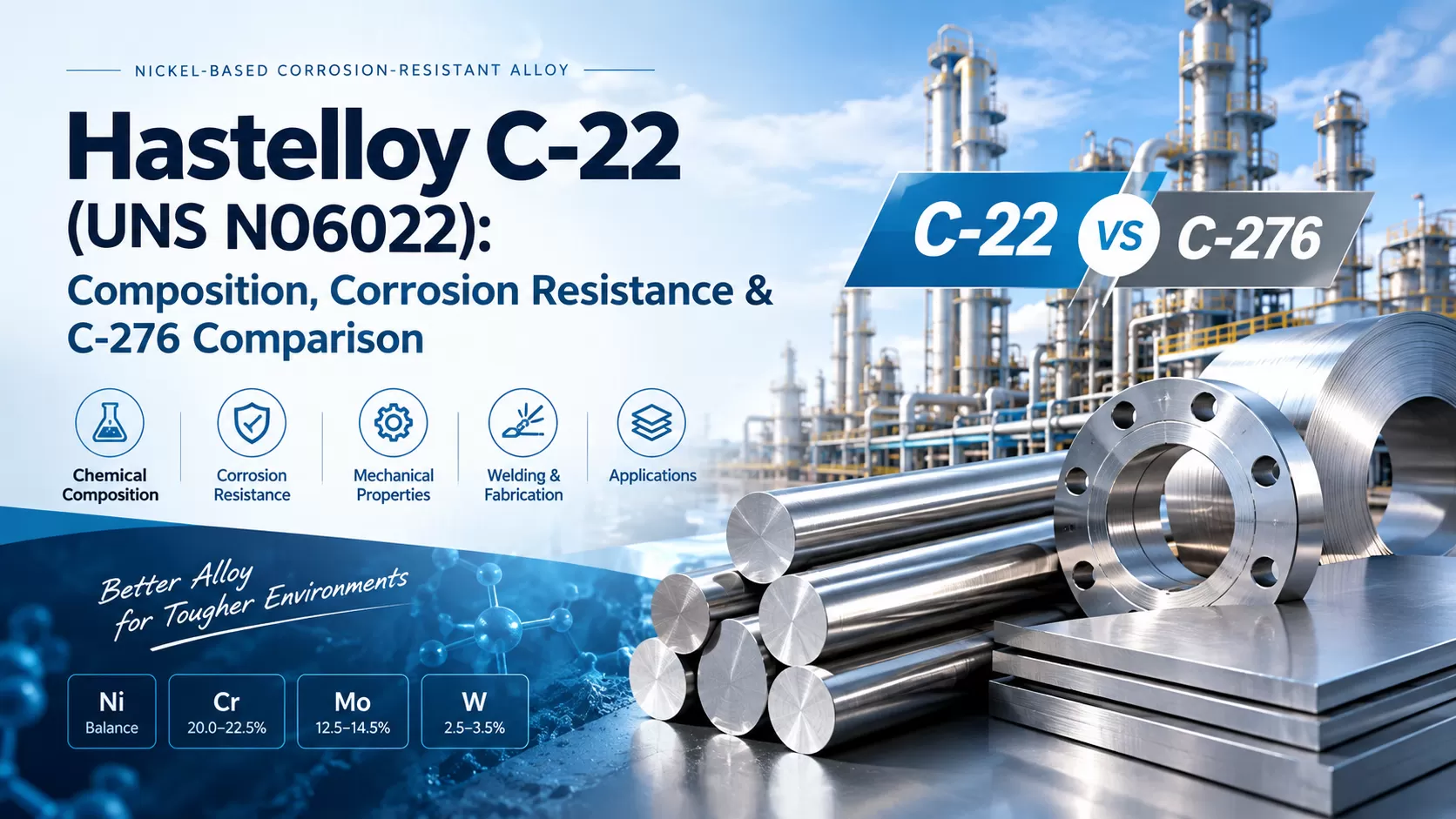
When selecting high-performance nickel alloys for corrosive and extreme environments, Hastelloy C276 and Hastelloy C22 are two of the most widely used choices. Both belong to the Hastelloy C-series and offer outstanding corrosion resistance, but their chemical composition, performance characteristics, and ideal applications differ in important ways.
This article provides a detailed comparison of Hastelloy C276 vs Hastelloy C22 to help engineers, designers, and procurement professionals make informed material decisions.
Hastelloy alloys are nickel-based superalloys known for their exceptional resistance to corrosion, high temperatures, and mechanical stress. The C-series is specifically designed for use in highly aggressive chemical environments, including acids, chlorides, and oxidizing media.
Among them, C276 is a long-established industry standard, while C22 is a more advanced alloy developed to deliver even broader corrosion resistance.
The most fundamental difference between Hastelloy C276 and C22 lies in their alloying elements.
| Element | Hastelloy C276 (%) | Hastelloy C22 (%) |
|---|---|---|
| Nickel (Ni) | Balance | Balance |
| Chromium (Cr) | ~15–16 | ~20–22 |
| Molybdenum (Mo) | ~15–17 | ~12.5–14.5 |
| Tungsten (W) | ~3–4.5 | ~2.5–3.5 |
| Iron (Fe) | ≤7 | ≤6 |
Key takeaway:
Hastelloy C22 has significantly higher chromium content, which greatly enhances resistance to pitting, crevice corrosion, and oxidizing environments.
Hastelloy C276 has higher molybdenum, contributing to strong resistance in reducing conditions.
Hastelloy C276 is well known for its ability to withstand:
Reducing acids (hydrochloric, sulfuric)
Chloride-containing environments
Wet chlorine gas
Stress corrosion cracking
It performs reliably in mixed chemical environments and remains one of the most versatile corrosion-resistant alloys available.
Hastelloy C22 offers superior overall corrosion resistance, especially in:
Strong oxidizing acids
Pitting and crevice corrosion environments
Chloride-induced corrosion
Mixed oxidizing and reducing conditions
Thanks to its higher chromium content, C22 generally outperforms C276 in the most aggressive and unpredictable chemical processes.
Verdict:
👉 Hastelloy C22 provides broader and more robust corrosion resistance than C276.
Both alloys share similar mechanical characteristics:
Excellent toughness and ductility
High strength at elevated temperatures
Good weldability using standard techniques
Suitable for cold and hot forming
However:
Hastelloy C276 is often considered slightly easier to fabricate due to its long history and extensive fabrication data.
Hastelloy C22 may require tighter process control but offers better long-term corrosion performance.
Chemical processing equipment
Heat exchangers
Reactors and pressure vessels
Pollution control and waste treatment systems
Oil and gas components
Pharmaceutical and biotech processing
Flue gas desulfurization systems
Advanced chemical reactors
Seawater and marine environments
Highly corrosive mixed-acid systems
Hastelloy C22 is generally more expensive than C276 due to higher chromium content and enhanced performance.
C276 is more widely available and often chosen when cost is a major consideration and conditions are well understood.
Choose Hastelloy C276 if:
You need proven performance in reducing environments
Budget constraints are important
The application has predictable corrosion conditions
Choose Hastelloy C22 if:
Maximum corrosion resistance is required
The environment involves both oxidizing and reducing agents
Long-term reliability and safety are critical
In the comparison of Hastelloy C276 vs Hastelloy C22, both alloys are excellent choices for extreme environments, but they serve slightly different purposes. C276 remains a reliable, cost-effective workhorse, while C22 represents a higher-performance solution for the most aggressive corrosion challenges.
Understanding the chemical environment, mechanical requirements, and budget constraints is key to selecting the right alloy for your application.
2026-09-20 00:00:00
2026-09-18 00:00:00
2026-09-04 16:07:31



25th floor, C3 Building, Wanda Plaza, Kaifu District, Changsha, Hunan Province, China
 en
en
 ko
ko
 ru
ru
 es
es
 ar
ar
 hi
hi