Nickel alloys are widely used in aerospace, energy, chemical processing, and high-temperature industrial applications due to their exceptional strength, corrosion resistance, and thermal stability. However, the outstanding performance of these alloys does not come from composition alone. Heat treating of nickel alloys plays a decisive role in tailoring their microstructure and mechanical properties.
This article explores nickel alloy heat treatment from the perspective of precipitation phases, common heat treatment methods, and their influence on material performance, providing a clear and practical understanding for engineers, metallurgists, and procurement professionals.
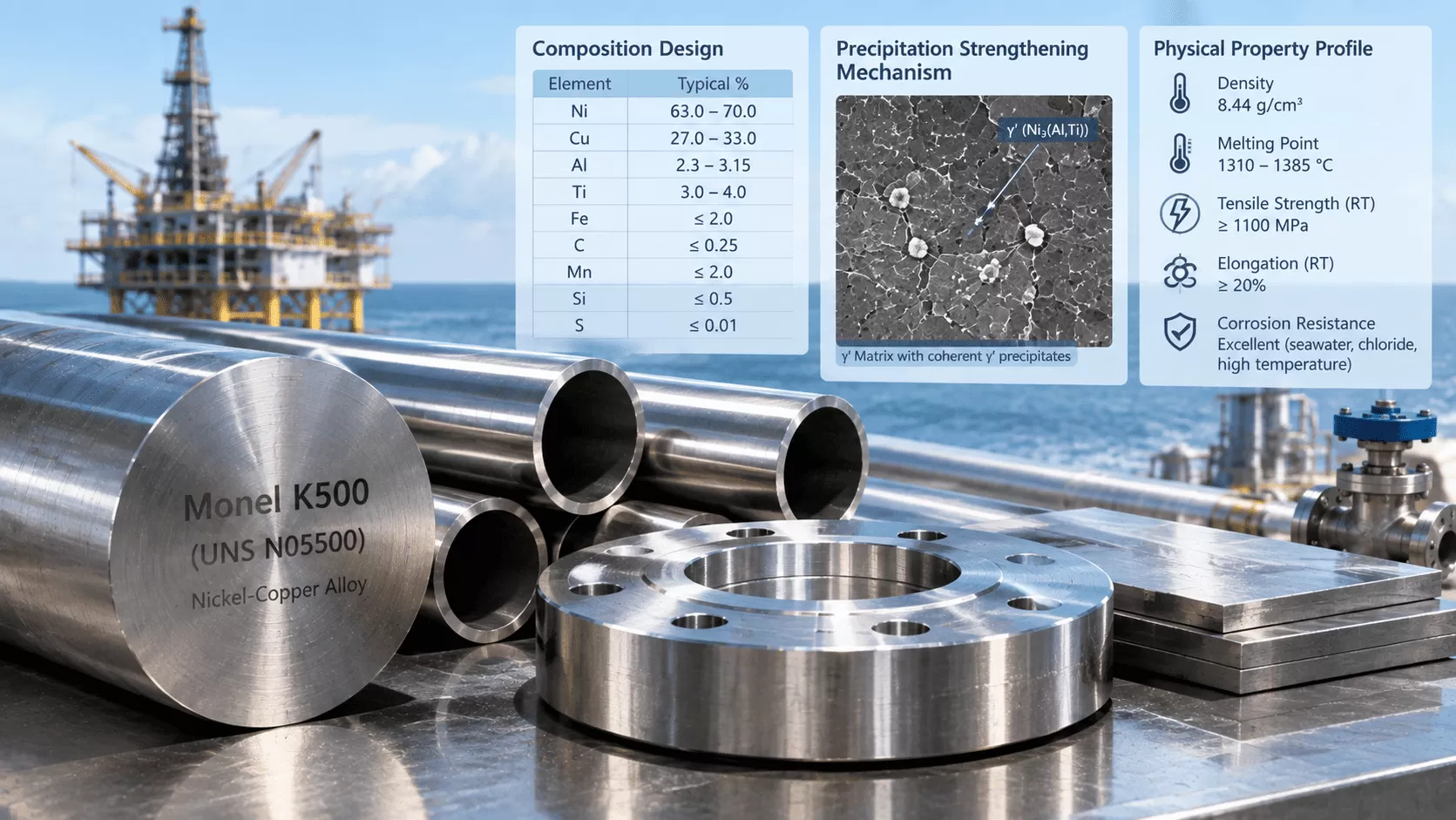
One of the defining characteristics of many nickel-based alloys is precipitation strengthening. During controlled heat treatment, fine secondary phases form within the matrix, significantly improving strength without sacrificing ductility.
γ′ (Gamma Prime)
A coherent intermetallic phase (Ni₃(Al,Ti)) that provides excellent high-temperature strength and creep resistance. Common in superalloys used for turbine blades.
γ″ (Gamma Double Prime)
A metastable phase (Ni₃Nb) that offers strong precipitation hardening at intermediate temperatures, particularly in alloys such as Inconel 718.
Carbides (MC, M₂₃C₆, M₆C)
These phases often form at grain boundaries and can enhance creep resistance, though excessive carbide formation may reduce corrosion resistance.
The size, distribution, and stability of these precipitates are directly controlled by heat treatment parameters such as temperature, holding time, and cooling rate.
Different nickel alloys require specific heat treatment strategies depending on their intended service conditions. Below are the most widely used methods.
Solution heat treatment involves heating the alloy to a temperature high enough to dissolve secondary phases into the matrix, followed by rapid cooling (usually water or air quenching).
Purpose:
Homogenize chemical composition
Dissolve undesirable precipitates
Prepare the alloy for subsequent aging treatment
This step is critical for ensuring consistent precipitation during aging.
Aging is performed at lower temperatures after solution treatment. During this process, controlled precipitation of strengthening phases occurs.
Key Benefits:
Significant increase in yield and tensile strength
Improved creep and fatigue resistance
Optimized balance between strength and toughness
The aging process may involve single-stage or multi-stage cycles, depending on alloy chemistry and performance requirements.
Stress relief heat treatment is used to reduce residual stresses introduced during machining, welding, or forming.
Advantages:
Minimizes distortion during service
Reduces the risk of stress corrosion cracking
Maintains dimensional stability
Unlike solution treatment, stress relief does not significantly alter the alloy's microstructure.
Proper heat treating of nickel alloys directly impacts their real-world performance.
High-Temperature Strength: Optimized precipitation phases maintain strength under extreme heat.
Creep Resistance: Stable precipitates slow down deformation over long service periods.
Corrosion and Oxidation Resistance: Controlled carbide formation helps preserve grain boundary integrity.
Fatigue Life: Uniform microstructures reduce crack initiation and propagation.
Incorrect heat treatment, on the other hand, may lead to over-aging, grain growth, or embrittlement, compromising component reliability.
To achieve consistent and repeatable results, consider the following best practices:
Strict control of furnace temperature uniformity
Accurate timing of soak and cooling stages
Clean furnace atmospheres to avoid surface contamination
Heat treatment procedures tailored to specific alloy grades
Adhering to recognized standards such as AMS, ASTM, or ISO specifications is essential for critical applications.
Heat treating of nickel alloys is a sophisticated but essential process that determines the final performance of high-value components. By understanding precipitation phases, selecting appropriate heat treatment methods, and carefully controlling processing parameters, manufacturers can unlock the full potential of nickel-based materials.
Whether used in aerospace engines or corrosive chemical environments, properly heat-treated nickel alloys offer unmatched reliability, strength, and longevity.
2026-09-20 00:00:00
2026-09-18 00:00:00
2026-09-04 16:07:31



25th floor, C3 Building, Wanda Plaza, Kaifu District, Changsha, Hunan Province, China
 en
en
 ko
ko
 ru
ru
 es
es
 ar
ar
 hi
hi