When comparing Inconel 625 vs 718, engineers and buyers are usually trying to answer one key question: Which nickel alloy performs better for my specific temperature, load, and corrosion conditions?
Both alloys are high-performance nickel-based superalloys widely used in aerospace, oil & gas, marine, and power generation industries. However, their mechanical behavior, corrosion resistance, machinability, and heat treatment response differ significantly.
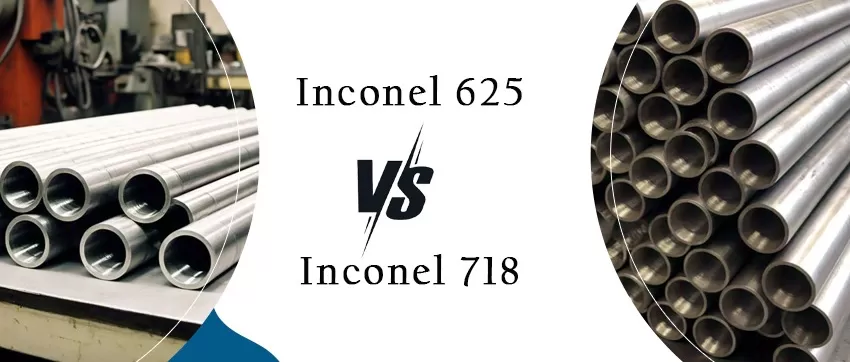
This complete guide compares composition, strength & hardness, high-temperature performance, corrosion resistance, machinability, real-world applications and selection recommendations.
| Element | Inconel 625 | Inconel 718 |
|---|---|---|
| Nickel (Ni) | 58-72% | 50-55% |
| Chromium (Cr) | 20-23% | 17-21% |
| Molybdenum (Mo) | 8-10% | 2.8-3.3% |
| Niobium (Nb) | 3.15-4.15% | 4.75-5.5% |
| Iron (Fe) | ≤5% | 18-21% |
| Titanium (Ti) | 0.4-1% | 0.9-1.3% |
| Aluminum (Al) | - | 0.2-0.8% |
Key Difference:
This explains why 718 achieves much higher strength after heat treatment.
| Property | Inconel 625 | Inconel 718 |
|---|---|---|
| Tensile Strength | 760 MPa | 1,270 MPa |
| Yield Strength | 310 MPa | 1,030 MPa |
| Elongation | 35% | 15-25% |
| Hardness | 90-95 HRB | 35-45 HRC |
If your application involves:
👉 Inconel 718 is significantly stronger.
If ductility and toughness are more important:
👉 Inconel 625 performs better.
If corrosion is your primary concern → Choose 625.
If strength at high temperature matters more → Choose 718.
If your project involves heavy fabrication or frequent welding, 625 is usually more practical.
Inconel 625:
It is preferred where corrosion resistance outweighs ultra-high strength.
Inconel 718:
It is one of the most widely used aerospace superalloys.
Marine environment
Acidic exposure
Complex welding fabrication
Moderate temperature (<650°C)
High mechanical load
Temperatures up to 700°C
Aerospace or turbine use
Creep resistance required
The real difference in the Inconel 625 vs 718 comparison comes down to:
1. Corrosion resistance vs mechanical strength
2. Fabrication ease vs heat-treated performance
There is no universally better alloy, only the right alloy for your operating conditions.
If you're unsure which grade fits your project, provide:
✔Working temperature
✔Applied stress/load
✔Exposure environment
✔Required product form (bar, plate, pipe)
Our engineering team can recommend the optimal nickel alloy solution.
2026-09-20 00:00:00
2026-09-18 00:00:00
2026-09-04 16:07:31



25th floor, C3 Building, Wanda Plaza, Kaifu District, Changsha, Hunan Province, China
 en
en
 ko
ko
 ru
ru
 es
es
 ar
ar
 hi
hi